
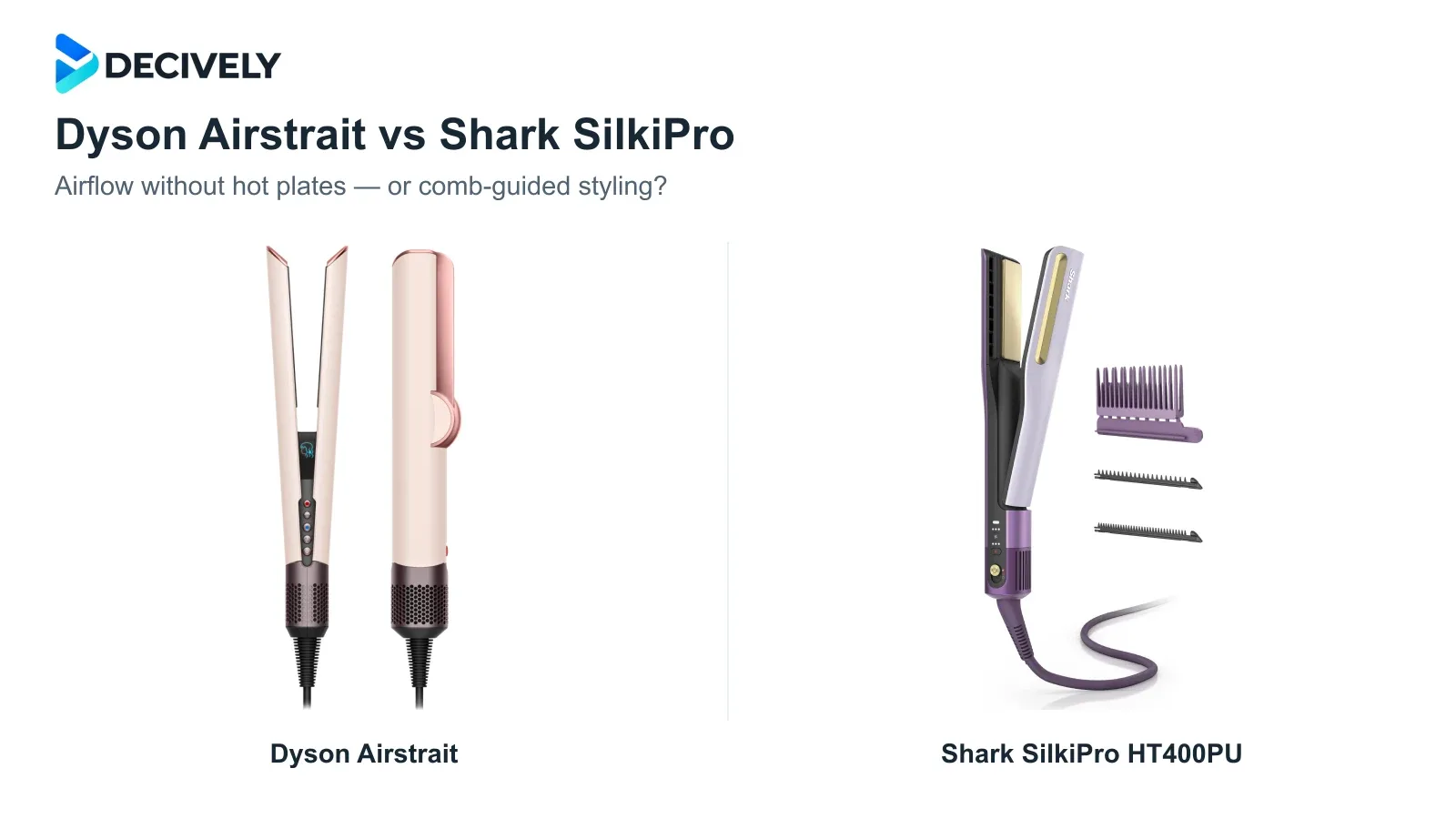
Dyson Airstrait vs Shark SilkiPro Straight looks like a simple price comparison until you examine how they work. Both dry and straighten hair, but Dyson uses directed airflow without hot plates. Shark combines airflow with heated ceramic plates and interchangeable combs. That difference should lead your buying decision.
Quick verdict
Choose Airstrait if avoiding heated straightening plates is your priority and you mainly want a naturally straight finish. Pay for that specific approach rather than expecting it to create curls or guarantee damage-free hair.
Choose SilkiPro for comb-guided control and dry-hair shaping when it costs substantially less. Its flexibility is useful, but the plates and learning curve are real trade-offs. Existing happy Airstrait owners have little reason to switch just for a newer product.
Affiliate links. As an Amazon Associate I earn from qualifying purchases.
Airstrait vs SilkiPro: what you are paying for
Airflow-only straightening is the key difference
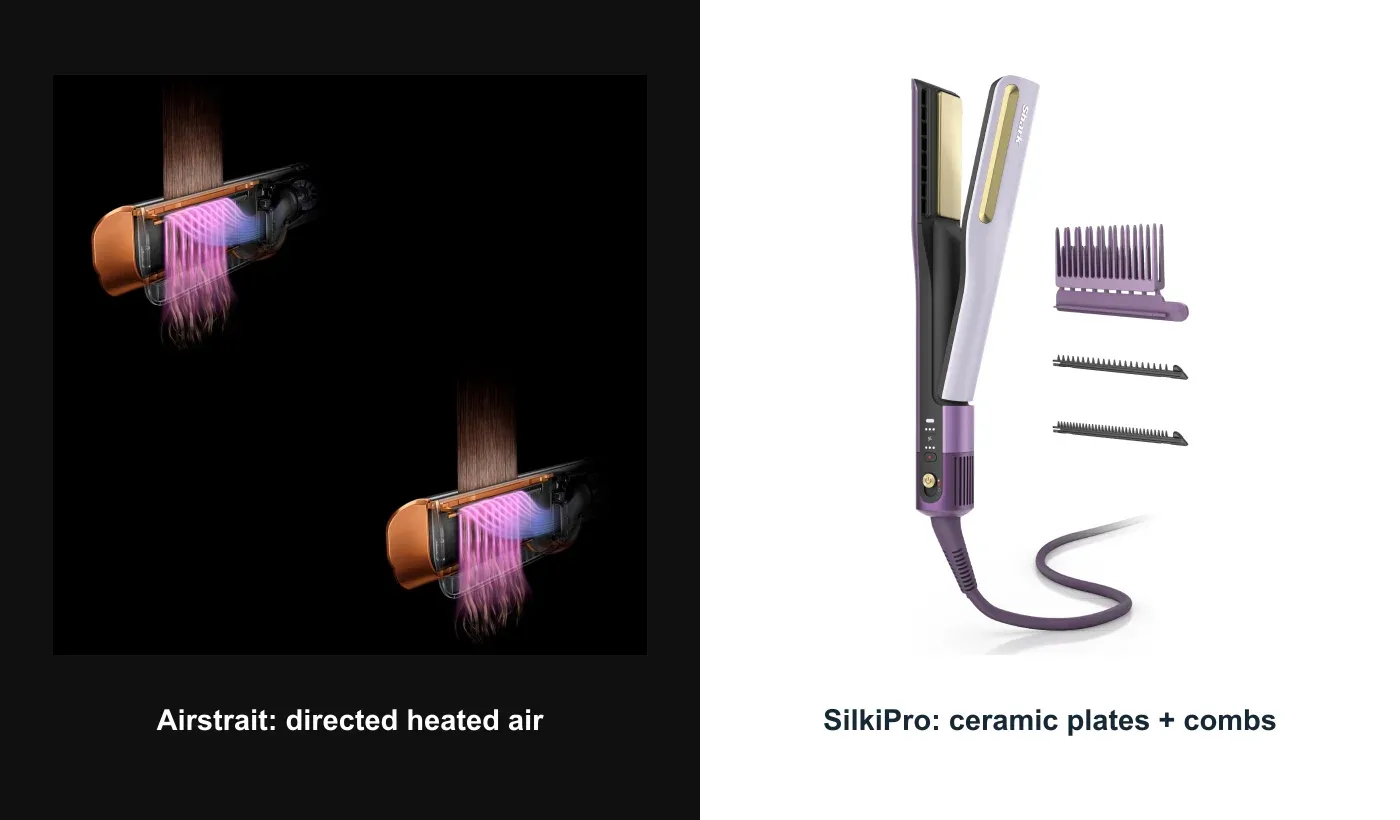
Official Dyson airflow visualization and Shark SilkiPro product photo, arranged by Decively. The Dyson cutaway uses another colorway to explain the same Airstrait mechanism; it is not an independent heat or damage test.
Airstrait still uses heat: it heats the air directed through the hair. “No hot plates” does not mean cold styling. SilkiPro’s ceramic plates add direct heated contact, while the combs guide strands through the tool. Neither should be treated like an ordinary dry-only flat iron on wet hair.
Shark’s “no heat damage” wording is qualified for wet-to-dry use. Dyson also attaches conditions to its damage claims. Those statements do not establish which tool will cause less long-term breakage for a particular person.
Real tests: a close race, with different finishes
One head-to-head test favored Shark’s handling
Cosmopolitan’s Lauren Gruber used the tools on opposite halves of her thick 2B waves. She recorded 11:31 with Dyson and 11:47 with Shark, preferred Shark’s combs and handling, but found the Dyson side smoother. Those half-head timings are one person’s results, not a universal speed ranking.
The combs do not remove the learning curve
TechRadar’s Victoria Woollaston spent four weeks with a UK SilkiPro on fine, naturally curly hair. She liked the shiny finish but found handling and comb technique took practice, and the motion-sensing pause could interrupt use. That review supports a learning-curve caution; it does not verify the contents or electrical specifications of this US box.
The practical question is whether a comb-guided pass feels easier in your routine. Lower listed weight can help, but grip, section size and the need to support the hair still matter. A familiar flat-iron motion is not proof that the correct wet-mode technique will feel identical.
Is Dyson worth the extra?
Yes, potentially: you specifically want to straighten without hot plates, prefer a naturally straight result, and accept Airstrait’s weight and premium. That is a clearer justification than paying more because it is Dyson.
Choose Shark instead: you want included combs, dry-hair bends and a lower entry cost. Check the live gap before buying; a major Dyson discount can change the calculation. For volume or curls, neither is a direct substitute for a blow-dryer brush or multi-styler.
Both linked US appliances are 120V. Airstrait is not universal voltage, and a plug adapter does not convert voltage. International buyers should select the correct local version. Follow each manual’s preparation, sectioning, cleaning and mode instructions; heated plates designed for wet mode do not make other flat irons safe to use on wet hair.
Common questions
Does Shark SilkiPro use hot plates?
Yes. It combines heated ceramic plates, airflow and interchangeable combs. Dyson Airstrait uses directed heated air without hot straightening plates.
Does SilkiPro HT400PU include a case?
The base US Plum package lists the tool and three combs, not a case. Other regional versions and bundles may differ; check the exact listing rather than relying on a UK review.
Research notes
Researched 19 October 2026. Decively has not hands-on tested these straighteners. Specifications and package contents come from official US pages; independent testing is attributed with hair type and regional limitations. No long-term comparative damage test or universal speed advantage is established. Amazon prices, sellers and delivery can change.
Dyson — Airstrait US specifications, box and travel FAQ Shark — SilkiPro HT400PU US specifications and box Cosmopolitan — Lauren Gruber’s direct half-head comparison TechRadar — Victoria Woollaston’s four-week SilkiPro review