

Room boundaries matter more than a whole-home number
For one open room, a larger properly sized purifier can be the simpler choice. For two rooms with closed doors, separate units usually make more sense. A purifier in a hallway cannot be assumed to deliver its advertised performance inside both bedrooms.
When choosing one large air purifier or two small ones, start with where people spend time and how doors are used. Add up ownership costs only after deciding where clean air needs to be delivered.
Compare the two layouts
On smaller screens, swipe the table to see every column.
Do not compare headline square footage alone
A coverage claim can use a slow air-change assumption that is not suitable for your intended use. Compare clean-air delivery rate, room volume and the stated test basis. The highest-speed CADR does not describe what the unit delivers in its quietest mode.
For an illustrative calculation, a 200-square-foot room with an 8-foot ceiling contains 1,600 cubic feet. Delivering 4.8 air changes per hour would require about 128 cubic feet per minute: 1,600 × 4.8 ÷ 60. This is a sizing example, not a guarantee of a particular health outcome or product’s low-speed performance.
When a larger unit is the better buy
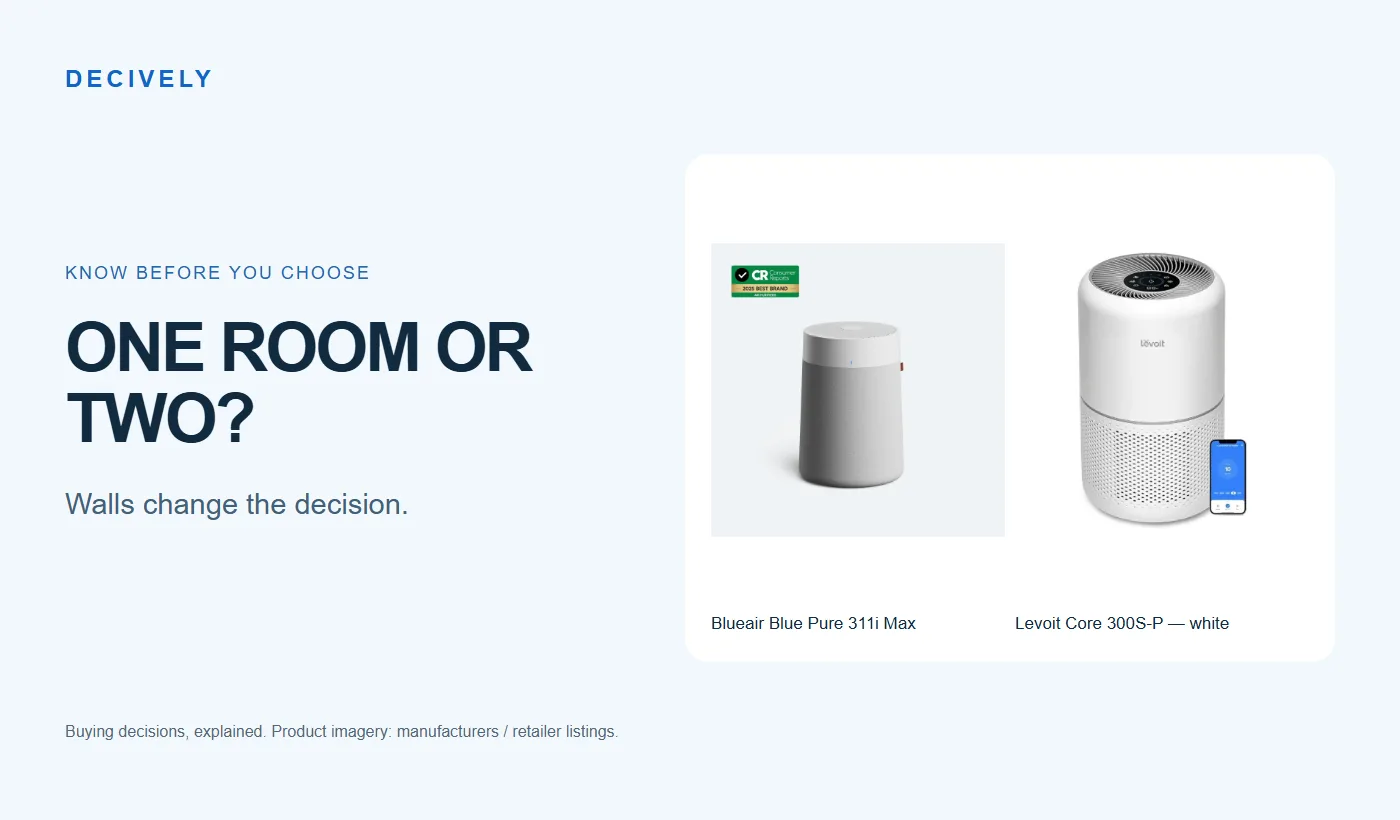
A larger unit can give you more airflow headroom in one shared space, with one filter to track and one set of controls. The Blue Pure 311i Max is worth comparing for that role. The current Blueair technical table lists 283 CFM smoke CADR and 439 square feet at 4.8 air changes per hour. Levoit lists the Core 300S-P at 141 CFM and 219 square feet at 4.8 air changes per hour. These ratings do not establish quiet-mode performance or coverage through closed doors. Blueair’s page title still refers to 465 square feet; use its updated technical table for this comparison.
The potential benefit is running the selected unit at a tolerable setting while still meeting your goal. Do not assume lower-speed output without a manufacturer specification or independent measurement.
When two smaller units are the better buy
Two suitably sized units let you filter a bedroom and an office independently. You can run the occupied room without relying on airflow through a doorway. The Core 300S-P is a compact example to assess for each room separately.
The trade-off is duplicate filter purchases, outlets and floor space. Two small units are not automatically cheaper or quieter than one large one. Compare the combined purchase price and the replacement-filter budget over the same period.
CHECK ON AMAZON · AFFILIATE LINKS
Check the room-by-room options
Confirm the exact model, included accessories, current price, seller and return terms.
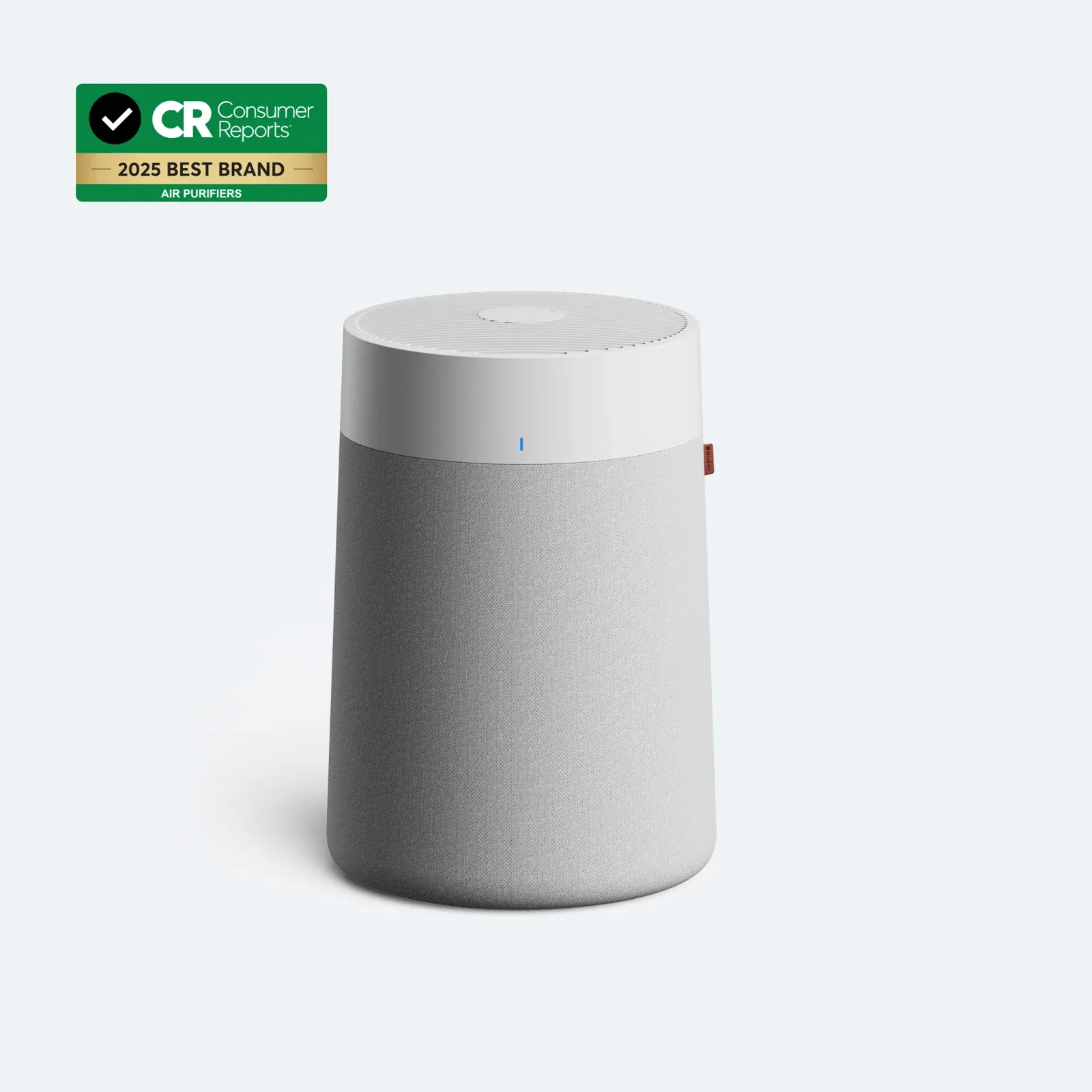
Blueair Blue Pure 311i Max
Compare for a larger single space using its rated CADR and acceptable fan speed.
Check price & availability on Amazon →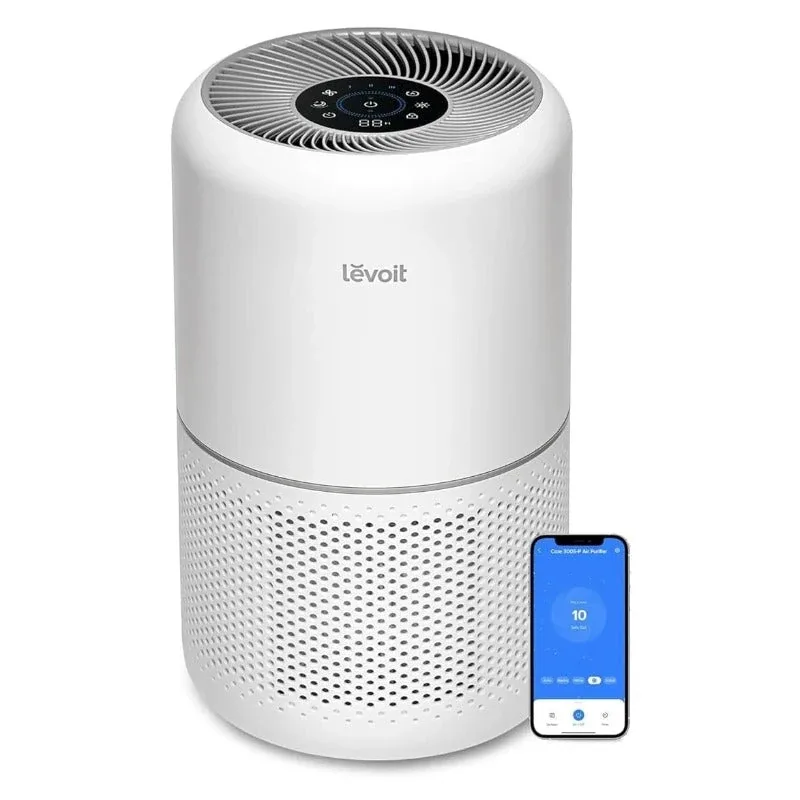
Levoit Core 300S-P — white
Compare for individual smaller rooms; a two-room setup needs two suitably sized units.
Check price & availability on Amazon →As an Amazon Associate, Decively earns from qualifying purchases. Prices and availability can change.
A placement plan that works with daily life
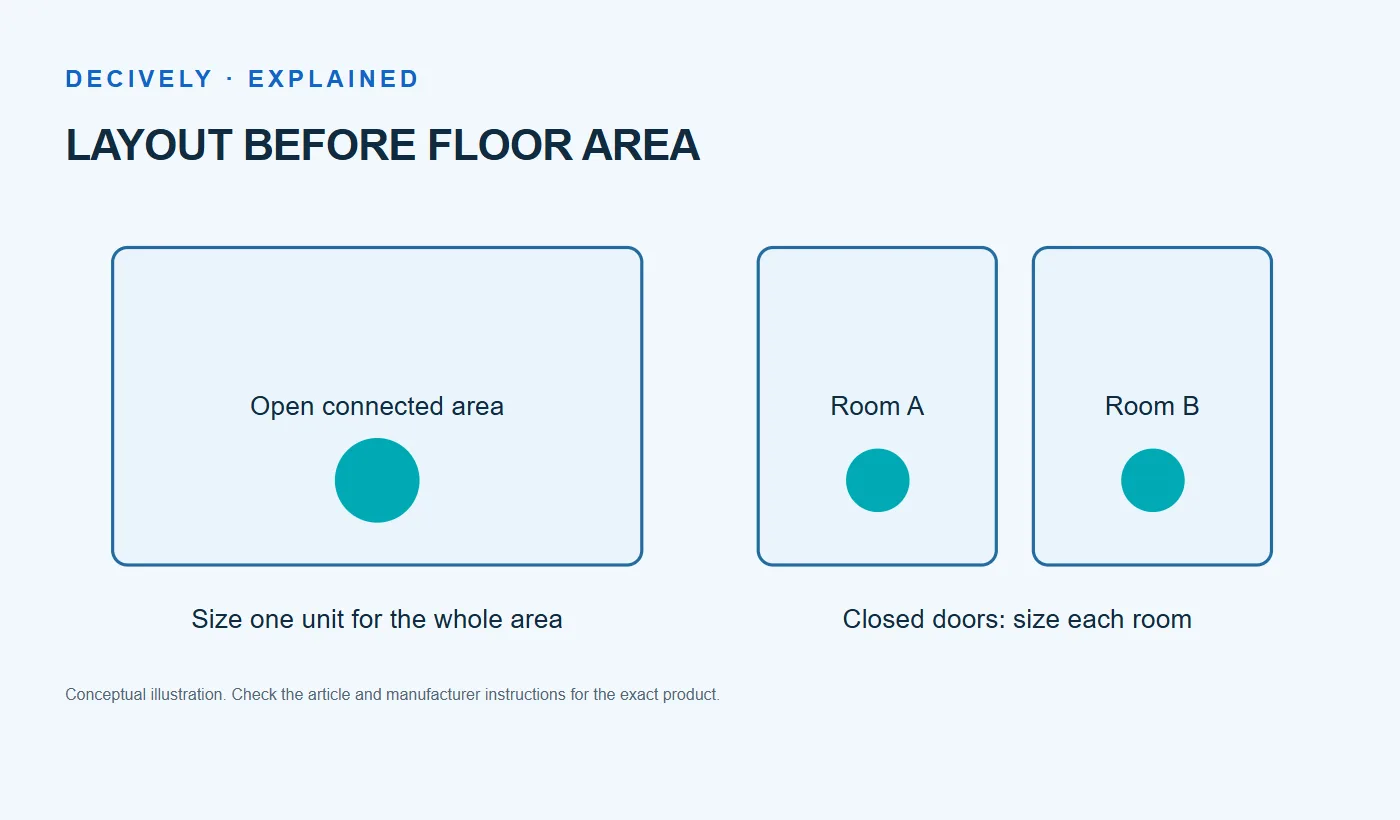
An open room and two closed rooms need different placement plans. Airflow arrows are conceptual, not measured. View image at full size →
Our recommendation
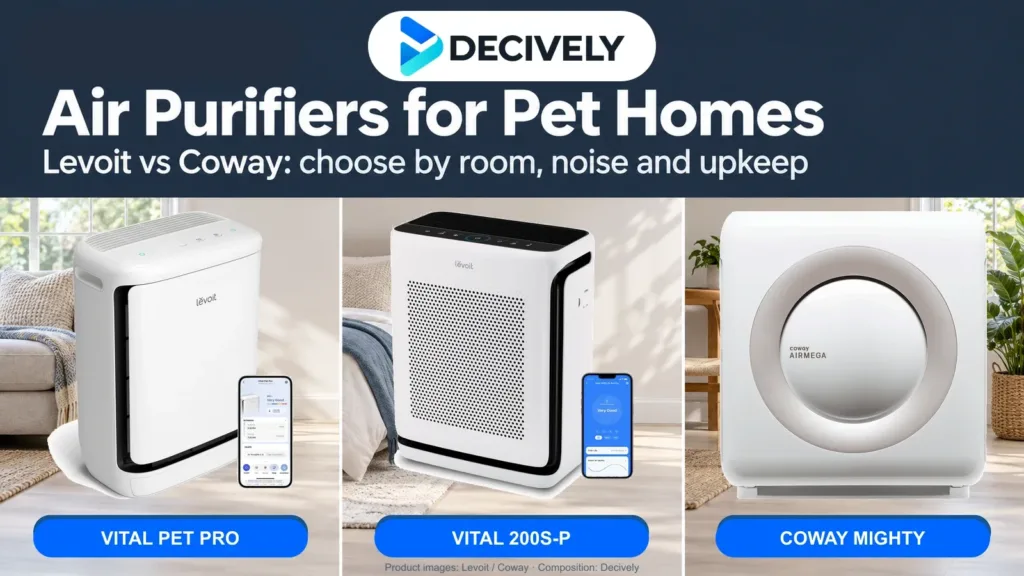
Buy for the rooms you actually use, not a whole-home marketing total. Start with one appropriately sized unit for one open space, or separate units for separate occupied rooms. See our bedroom purifier guide for nighttime considerations and our pet-home guide for particle and cleaning trade-offs. This is research-based sizing advice, not an airflow test.
Research notes and sources
This guide compares published documentation and product information. Decively has not performed hands-on testing of these products for this article. Check the current model, compatibility and terms before buying.
Product photographs: manufacturer or retailer imagery. Diagrams: Decively explanatory illustrations, not test results or software screenshots.