
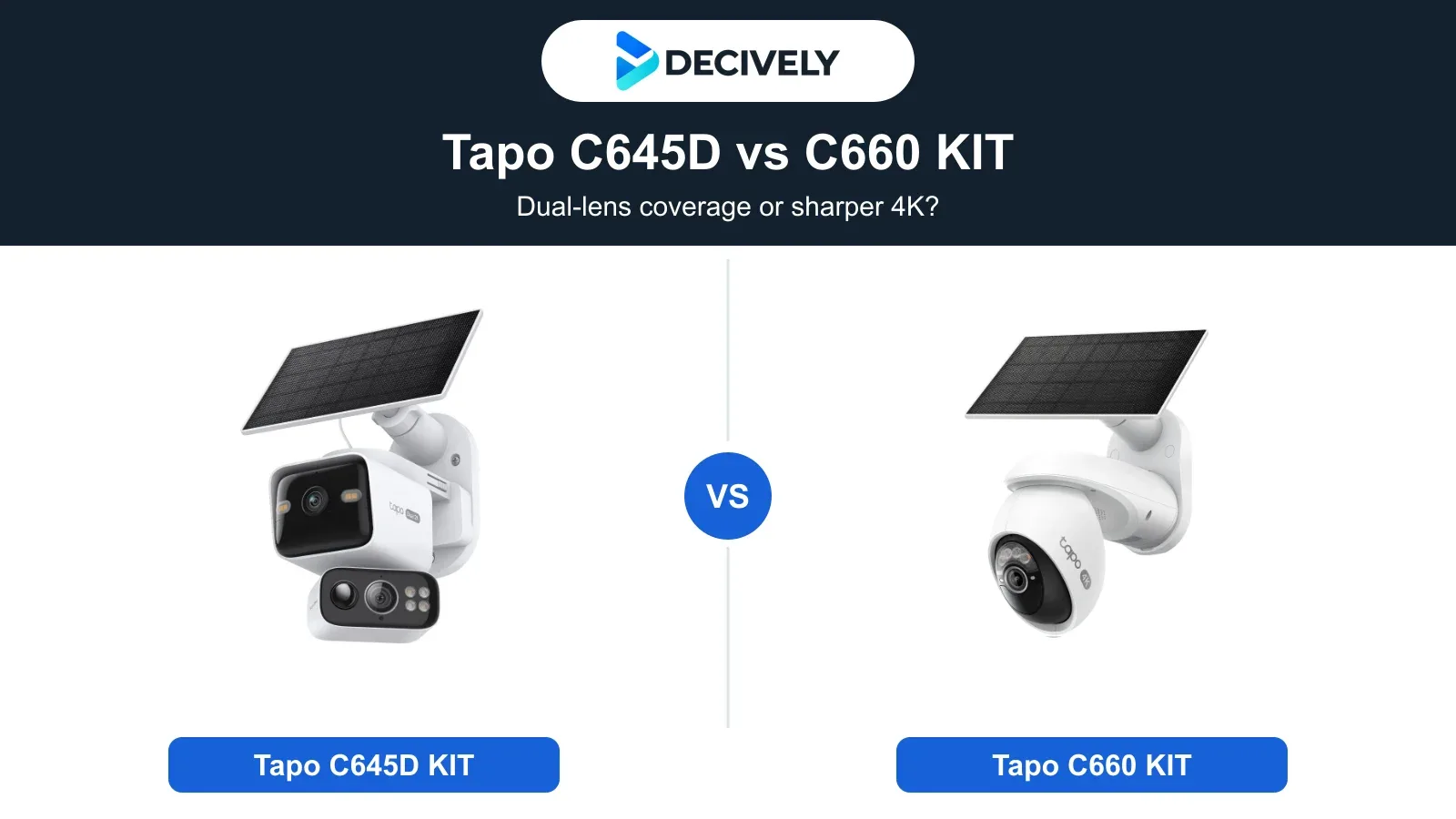
The Tapo C645D vs C660 choice is about what happens when the camera turns away. The C645D KIT keeps a fixed overview alongside a moving second view; the C660 KIT puts 4K resolution into a single pan-and-tilt camera.
Quick verdict
Choose the C645D KIT to keep the driveway in view while following someone. Choose the C660 KIT when a higher-resolution single view matters more. Both include a solar panel, support local storage and need a practical sunny mounting location. Neither is a substitute for full-frame-rate continuous recording.
Affiliate links. As an Amazon Associate I earn from qualifying purchases.
FOR AN OVERVIEW PLUS TRACKING
Tapo C645D KIT
White · one dual-lens camera + solar panel. Two 2K views help you watch the wider scene while following movement. Both lenses share one mounting location.
FOR A HIGHER-RESOLUTION VIEW
Tapo C660 KIT
White · one 4K camera + solar panel. A sharper single-view specification for inspecting and cropping a scene. Turning to follow someone changes what that view covers.
C645D vs C660: the practical differences
Why two views can matter more than 4K
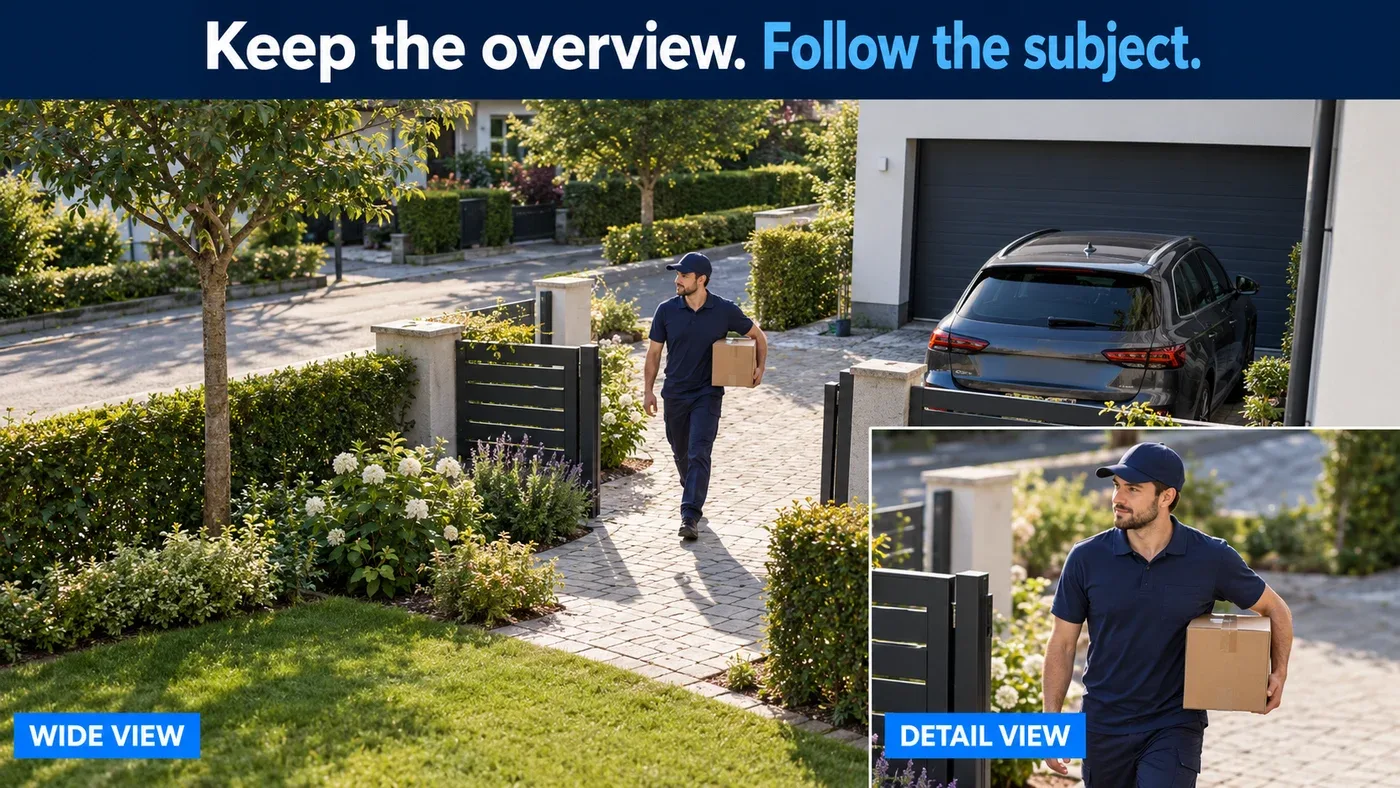
Generated illustration of an overview and a detail view. Not Tapo footage, an app screenshot or a resolution test.
Imagine a delivery driver walking toward your side gate while another person reaches the driveway. The C645D’s fixed lens can retain the overview while the lower lens follows the driver. With the C660, the single camera changes direction to track; its 360° coverage is not a live view of every direction at once.
In GadgetGuy’s C645D review, Adam Turner demonstrated the lower lens following a person beyond the fixed lens’s view. He also found the microphone disappointing at distance and in wind. The second lens adds coverage flexibility; it does not remove every blind spot or guarantee useful two-way conversations.
The C660’s 4K frame offers more pixels for a single view, with a narrower field of view than the C645D’s wide lens. That makes it a sensible candidate for inspecting one approach. It does not establish a guaranteed face or license-plate reading distance. These independent reviews were not a controlled head-to-head image-quality test.
Solar charging: plan the panel position first
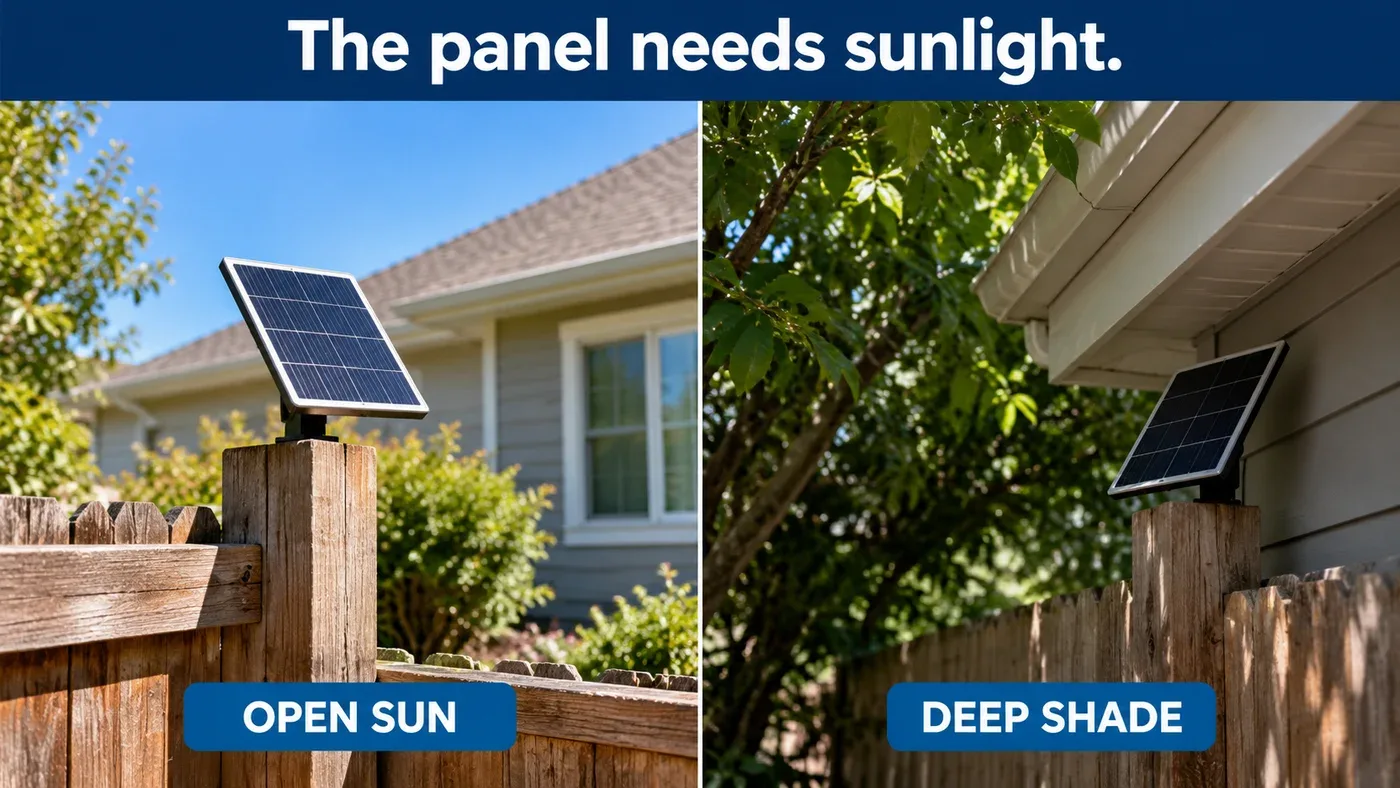
Generated illustration of sunny and shaded panel positions. Generic panels, not Tapo product photography or measured charging results.
Tapo claims a day of operation from around one hour of direct sun for the C645D and 45 minutes for the C660 under specified laboratory conditions. Treat those as manufacturer benchmarks, not promises for a shaded winter garden. Both kits include an extension cable so the panel can sit separately from the camera.
TechRadar reviewer Nico Arboleda found the C660 generally stayed charged with solar power, but enabling 24/7 Capture increased consumption enough that he eventually recharged it indoors. That is a workload-and-location example, not a battery-life result transferable to every home or the C645D.
Before drilling, check sunlight at different times of day and Wi-Fi at the actual mounting point. Both models specify charging at 32–113°F (0–45°C), even though their operating range extends below freezing. For a weak connection, use our Wi-Fi coverage guide before paying for more camera resolution.
What 24/7 Capture actually saves
There can be gaps between interval images. If your requirement is an uninterrupted record of every movement, neither kit should be bought on the strength of the “24/7” label alone. Tapo’s support guide distinguishes this mode from continuous recording.
For the simplest subscription-free setup, budget for a suitable microSD card and confirm local recording is enabled. Person/pet/vehicle detection does not require a cloud plan. Paid Tapo Care adds cloud event storage; it is not the same thing as local interval capture. A card inside the camera also leaves recordings physically with the device.
Which kit fits your home?
C645D KIT: the stronger fit when you want an overview plus tracking from one mounting point—such as a driveway beside a path. Two lenses still cannot see around a building corner; use separate camera positions for physically separated areas.
C660 KIT: the more focused choice when one approach matters most and you prefer higher-resolution footage from that view. Judge the current kit-price gap against your actual coverage need, rather than treating either model as an automatic upgrade.
Before buying either: confirm solar exposure, Wi-Fi and local storage. Neither supports RTSP/ONVIF integration for a conventional third-party NAS/NVR setup. These Amazon.com links are the white camera-and-panel kits; check local delivery and regional kit contents. For a separate indoor-camera decision, see our Blink Mini 4K+ comparison.
Research notes
Research checked October 28, 2026. Decively has not physically tested these cameras. Specifications and recording behavior come from current US Tapo pages and support documentation. Separate Australian hands-on reviews are attributed to GadgetGuy and TechRadar; they do not establish a controlled comparison. Recommendations are editorial interpretation. Featured product images: TP-Link/Tapo, independently composed with the approved Decively logo; products not shown to scale. Body scenes are generated illustrations. Exact Amazon.com kits and both decively-20 links were checked through Associates Link Checker.
Tapo — C645D KIT overview and solar claim Tapo — C645D KIT technical specifications Tapo — C660 KIT overview and solar claim Tapo — C660 KIT technical specifications Tapo support — 24/7 Capture, storage and battery limitations Tapo support — battery-camera RTSP/ONVIF limitations GadgetGuy / Adam Turner — C645D hands-on review TechRadar / Nico Arboleda — C660 hands-on review TP-Link — C660 press imagery