
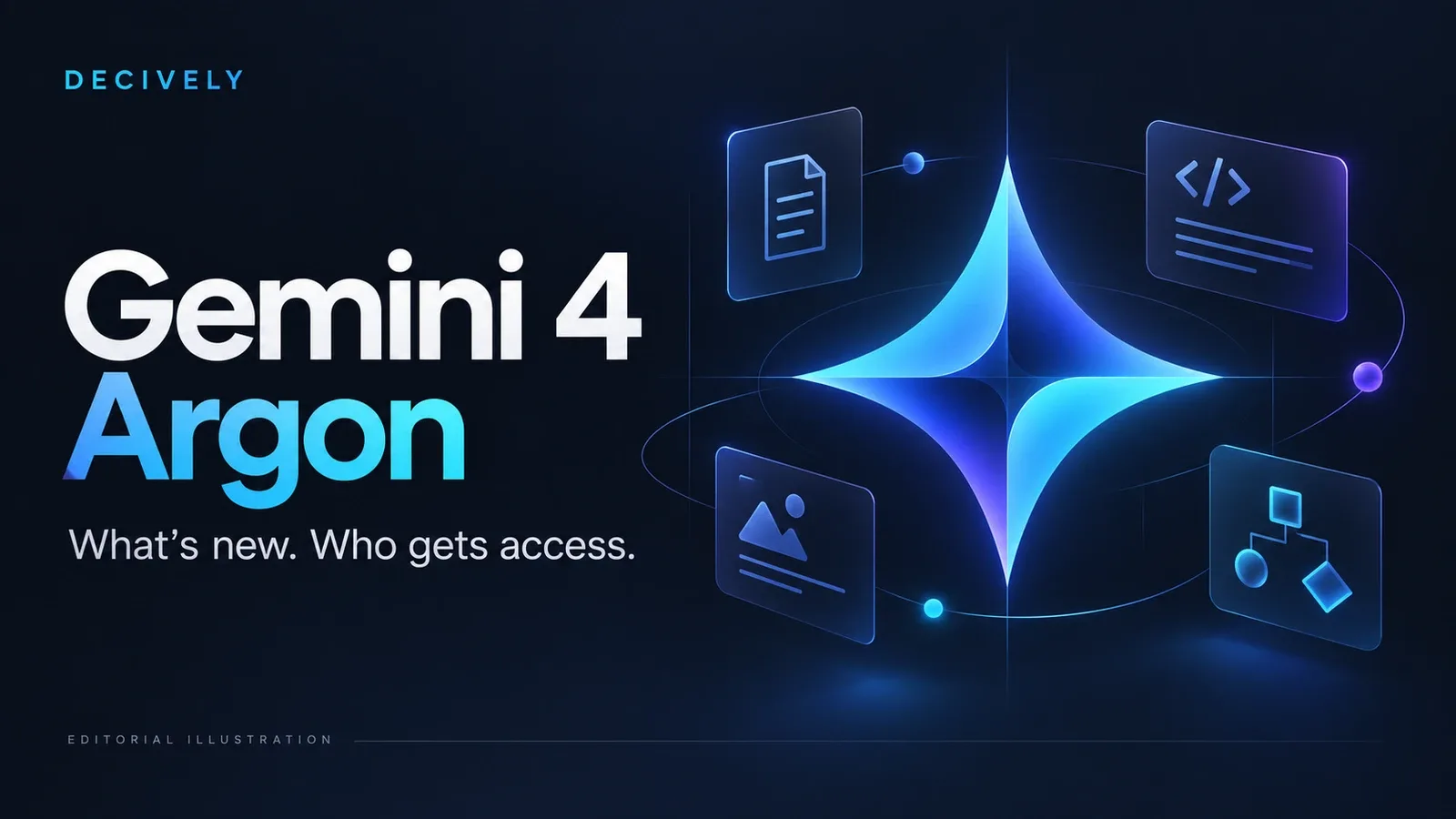
Gemini 4 Argon is Google’s latest frontier AI announcement, but a launch headline is not the same as an available upgrade. The useful questions are what has changed, who can access it and whether it solves a problem your current AI tools cannot.
Google announced the model on September 30, 2026. This guide separates confirmed launch details from our editorial assessment. We have not tested Argon or received early access.
Sources and availability checked October 5, 2026. No affiliate links.
Gemini 4 release date: announcement versus access
The announcement describes a model aimed at complex, extended workflows, including software engineering and enterprise knowledge work. Initial access is restricted; broader expansion is planned, beginning with paid API customers and Google AI Ultra subscribers. Google has not given a firm broad release date.
For a reader, the distinction is practical: do not subscribe or reorganize a project on the assumption that the new model is already selectable in your account. Check the actual model list and the terms for your product when wider access arrives.
What is new in Gemini 4 Argon?
One announced change is an output limit of one million tokens, up from 64,000. That is an output allowance—not a claim that the input context window has the same size.
A longer response budget could make a difference when work involves many connected steps. Imagine an assistant drafting a migration plan, generating code, explaining dependencies and documenting the result. Keeping that work coherent matters more than simply producing more text.
However, a larger allowance does not establish that every generated step is correct. Our view: the valuable improvement would be fewer broken handoffs between tasks, with evidence that the resulting work remains accurate and reviewable.
Gemini 4 availability: can you use it yet?
Google DeepMind’s Fairwind program offers selected partners access to Argon for defensive cybersecurity work. It prioritizes governments, critical infrastructure and technology platforms. Participation is vetted and use is restricted to defensive and academic tasks; partners cannot resell or redistribute access.
This is a specialized access program. An application is not equivalent to joining an ordinary consumer beta.
The public Gemini Developer API pricing catalog we checked on October 5 did not list Argon. That does not rule out selected partner access, but it means the launch announcement alone is insufficient proof of a generally available developer endpoint.
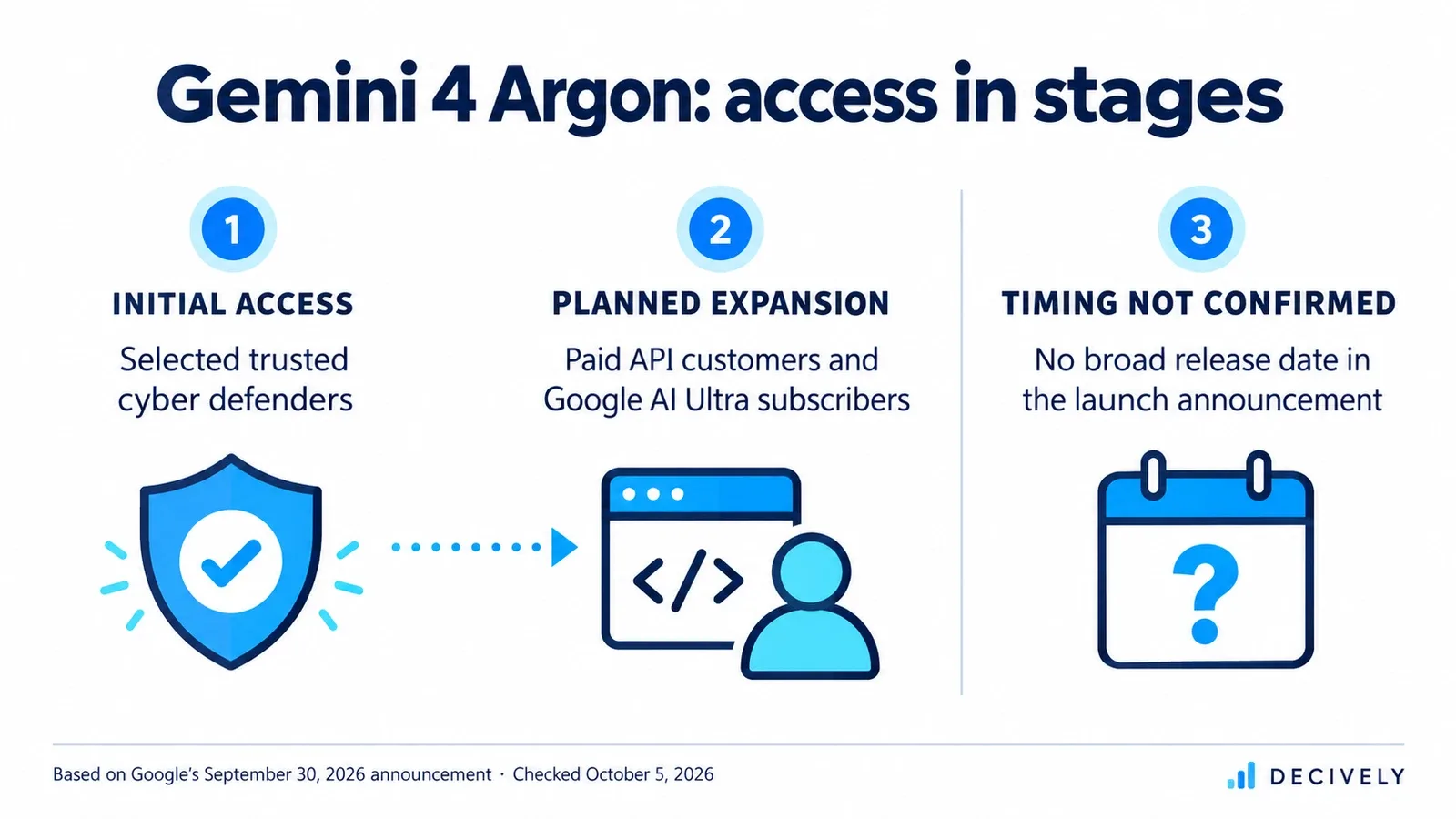
Access illustration based on the launch announcement. Planned expansion is not presented as already live.
Gemini 4 pricing: announced API costs
Introductory API pricing is $2 per million input tokens and $10 per million output tokens. Google lists subsequent rates of $4 and $20, respectively, and a 95% input-price discount for cached input. The announcement does not specify when introductory pricing ends.
These are usage rates, not a consumer subscription price. A workflow’s bill depends on how much it sends, generates and repeats. More output can mean a larger bill even when the price per token appears reasonable.
Before adopting it, estimate the cost of a completed task, including retries and human review. Compare that figure with your existing workflow rather than comparing headline token prices alone.
What Gemini 4 benchmarks do not tell you
Google’s evaluation methodology generally reports Argon results as pass@1, meaning one attempt, and uses its highest thinking level unless noted. Many competing-model figures come from those providers’ reported results; some evaluations use different tools or harnesses.
Those conditions matter when interpreting a leaderboard. A benchmark cannot tell you the latency of your application, the quality of your private documents or how reliably an assistant handles your particular instructions.
Once access is available, use a small set of representative tasks with clear acceptance criteria. Record correctness, completion time, cost and the edits you make. Include an example where the assistant should ask for clarification instead of inventing missing information.
Our take: what matters before switching
The direction is interesting: AI tools are being positioned for longer pieces of work, where a useful result depends on planning and continuity. For website owners and small teams, the potential benefit is spending less time stitching together separate outputs.
My concern is that a polished, lengthy answer can hide mistakes. Keep checkpoints for changes that affect a live website, customer information or business decisions. Review a concrete result before granting an assistant permission to act.
Gemini 4 is worth following, but it is too early for us to recommend switching. Wait for confirmed access, evaluate it against work you actually do and decide whether the improvement justifies the total cost.