

Kasa KL125 review: make a familiar lamp more useful
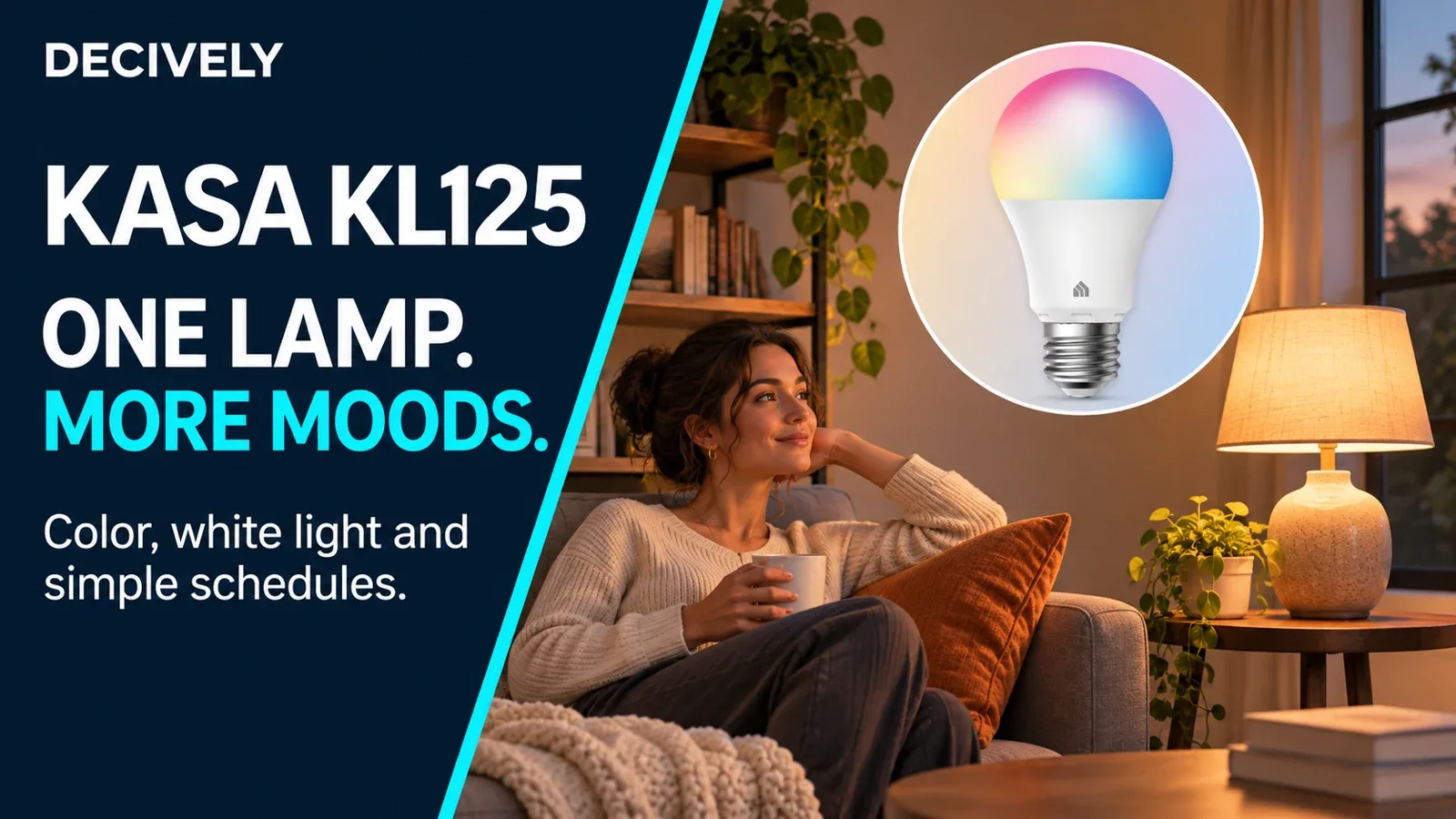
A softer light after dinner can make an ordinary room feel more welcoming. The Kasa KL125 gives a suitable lamp adjustable white light, color and schedules, without asking you to buy a separate lighting hub.
This Kasa KL125 review covers the US A19/E26 bulb sold individually under Amazon ASIN B08TB8QBB1. Its strongest value is flexibility: one bulb can provide practical white light for everyday tasks and a gentler setting for winding down.
The buying case: choose it for a compatible indoor lamp and an Alexa, Google Home or Kasa household. Look elsewhere if Matter, native Apple Home support or conventional wall-dimmer compatibility is essential. This is a research-based assessment; Decively has not physically tested the bulb.
As an Amazon Associate, Decively earns from qualifying purchases, at no additional cost to you.
CHECK ON AMAZON · AFFILIATE LINKS
Check the KL125 single-bulb listing
Confirm the exact model, included accessories, current price, seller and return terms.
Kasa KL125 — US E26 single bulb
Color and tunable white; 2.4 GHz Wi-Fi; no Matter or native Apple Home.
Check price & availability on Amazon →As an Amazon Associate, Decively earns from qualifying purchases. Prices and availability can change.
What the US bulb actually provides
800 lumens is the published white-light output; do not assume every saturated color produces the same usable brightness.
On smaller screens, swipe the table to see every column.
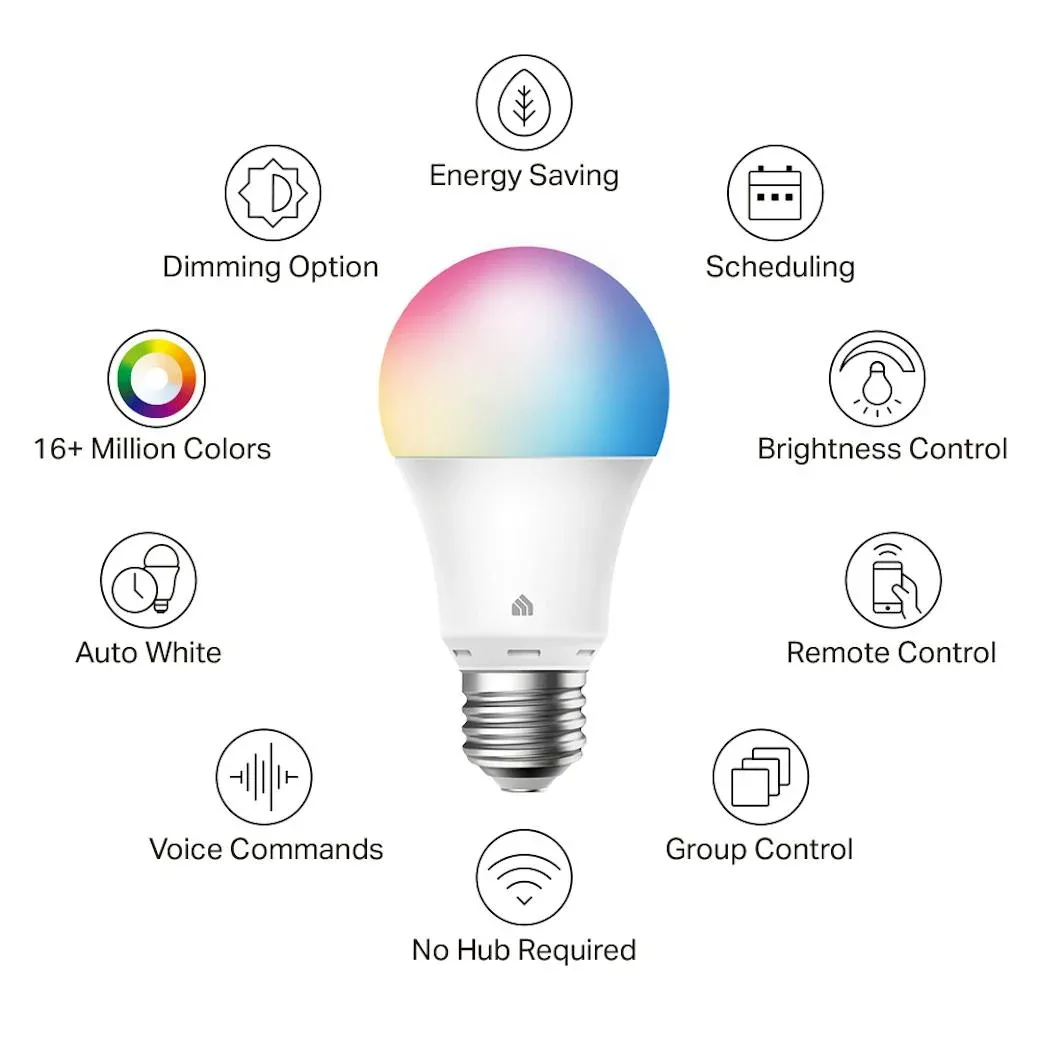
Official Kasa KL125 feature image from TP-Link. Manufacturer illustration; it does not document Decively testing. View image at full size →
Where the convenience earns its place
Start with a lamp you already use every evening. A warm preset can suit television or conversation, while a brighter white setting helps when sorting paperwork. Color is an extra option, rather than the only reason to replace an ordinary bulb.
A useful first routine might turn the lamp on near your usual arrival time and off at bedtime.
For a rented home, changing a suitable bulb also avoids replacing wall hardware. That makes starting with one lamp a manageable way to decide whether connected lighting fits your habits.
Check the socket, fixture and wall control
App dimming and wall dimming are different. TP-Link says not to use its smart bulbs with standard in-wall dimmers. Turning an existing dimmer fully up does not establish compatibility.
The installation guide also excludes totally enclosed and recessed luminaires, plus external photosensors, motion sensors and timers. A shaded table lamp with appropriate ventilation is a more straightforward candidate, provided its socket, voltage and instructions match.
Switch power off and allow the old bulb to cool before replacement. Once configured, leave the ordinary lamp or wall switch on: cutting mains power makes the smart controls unavailable. Explain this to everyone who uses the room so a familiar switch does not quietly defeat the schedule.
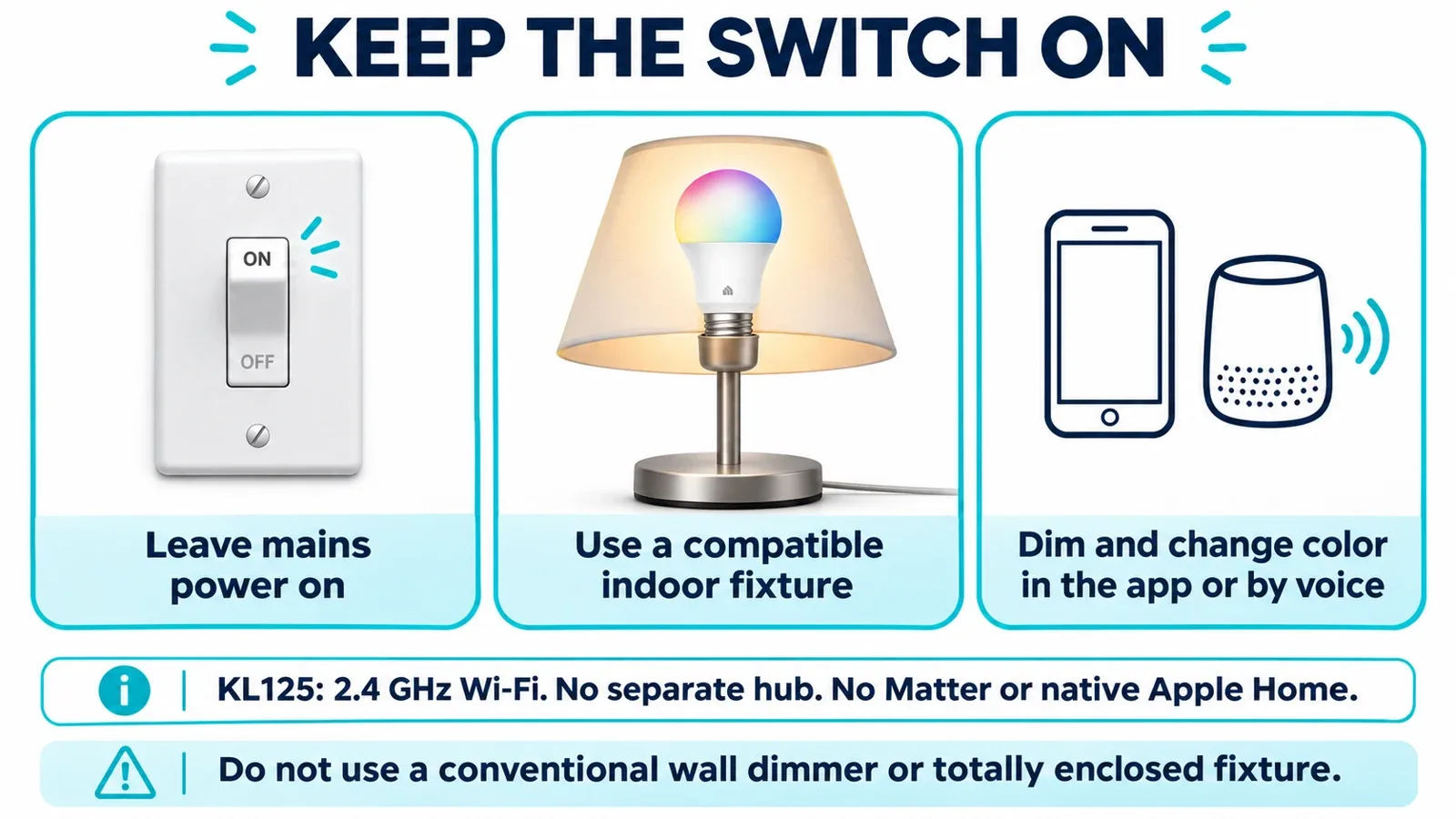
Illustrated KL125 compatibility checklist: keep power on and use a suitable indoor fixture. Editorial illustration, not a test photograph. View image at full size →
CHECK ON AMAZON · AFFILIATE LINKS
Match the bulb to your lamp before buying
Confirm the exact model, included accessories, current price, seller and return terms.
Kasa KL125 — US E26 single bulb
Color and tunable white; 2.4 GHz Wi-Fi; no Matter or native Apple Home.
Check price & availability on Amazon →As an Amazon Associate, Decively earns from qualifying purchases. Prices and availability can change.
Wi-Fi, voice assistants and ongoing costs
Setup uses the Kasa Smart app and a TP-Link account. Connect the bulb to a secured 2.4 GHz Wi-Fi network, give it a useful name and check available firmware updates. A dual-band router can be suitable; the bulb simply needs access to its supported band.
There is no separate lighting hub and no required subscription for ordinary Kasa bulb control. The app is described as free. Internet service and any optional voice-assistant hardware are separate costs; hub-free does not mean every service works without a network.
Alexa and Google Assistant support can make an awkward bedside switch easier to reach. Account linking is part of those integrations. The KL125 is not advertised as a Matter bulb, and buying a Matter controller does not add that protocol to it.
Check Wi-Fi coverage at the lamp itself. See Decively’s guide to fixing weak Wi-Fi in one room if the intended location struggles. Remote control and cloud voice services depend on working internet connectivity.
When another lighting approach makes more sense
A single connected bulb is a poor fit when several people expect the wall switch to control a whole room conventionally. Consider whether you want control of the light source or of the circuit before buying multiple bulbs. Our smart home gadgets buying guide helps you compare a connected bulb with plugs and other ways to automate everyday routines.
Choose an explicitly compatible Matter model if broad platform flexibility is the priority. Choose a brighter bulb if the room needs more illumination. Neither a color wheel nor an automation schedule compensates for insufficient light where you read.
Verdict: a useful upgrade for one compatible lamp, especially in an existing Kasa or Alexa/Google household.
CHECK ON AMAZON · AFFILIATE LINKS
Compare the exact model, seller and pack size
Confirm the exact model, included accessories, current price, seller and return terms.
Kasa KL125 — US E26 single bulb
Color and tunable white; 2.4 GHz Wi-Fi; no Matter or native Apple Home.
Check price & availability on Amazon →As an Amazon Associate, Decively earns from qualifying purchases. Prices and availability can change.
Research disclosure and primary sources
Researched November 5, 2026 using manufacturer documentation and the US Amazon catalog. No hands-on brightness, reliability or energy measurements were performed. Amazon identifies B08TB8QBB1 as the one-pack KL125; price and stock were not verified.
Sources: Kasa product specifications; installation and user guide; bulb compatibility FAQ; V4 datasheet.