
Start with the source of the echo
If you are wondering how to reduce echo in a room, start with the surfaces around you. Bare walls, glass and hard floors reflect speech; sound can linger after you stop talking. Soft furnishings and acoustic absorbers can reduce those reflections, but the useful purchase depends on which surfaces are exposed.
Our practical recommendation: try the furnishings you already own, improve microphone placement, then add treatment where the room still sounds lively. A rug suits an exposed floor; full curtains suit a large window; fabric-covered acoustic panels offer a more targeted wall treatment.
This is a research-based buying guide, not a hands-on test of the products below. As an Amazon Associate, Decively earns from qualifying purchases. We do not promise a measured reduction in echo from an untested product.
How to reduce echo in a room: identify the right problem
Room reverberation: your voice sounds hollow or continues ringing after a clap. Repeated reflections blur speech; a distinct repeated sound is an echo. A clap and a short voice recording are useful clues, not calibrated acoustic measurements.
Call echo: someone hears their own voice returned through your microphone. Try headphones and check the call app’s audio settings first. Shure’s guidance on acoustic echo cancellation explains this loudspeaker-to-microphone problem. Buying wall panels may not resolve its underlying cause.
Outside noise: traffic, neighbors or sound traveling through a door is a different issue. Absorbing reflections inside the room does not make its walls soundproof. That distinction is essential when deciding how to reduce echo in a room without buying the wrong fix.
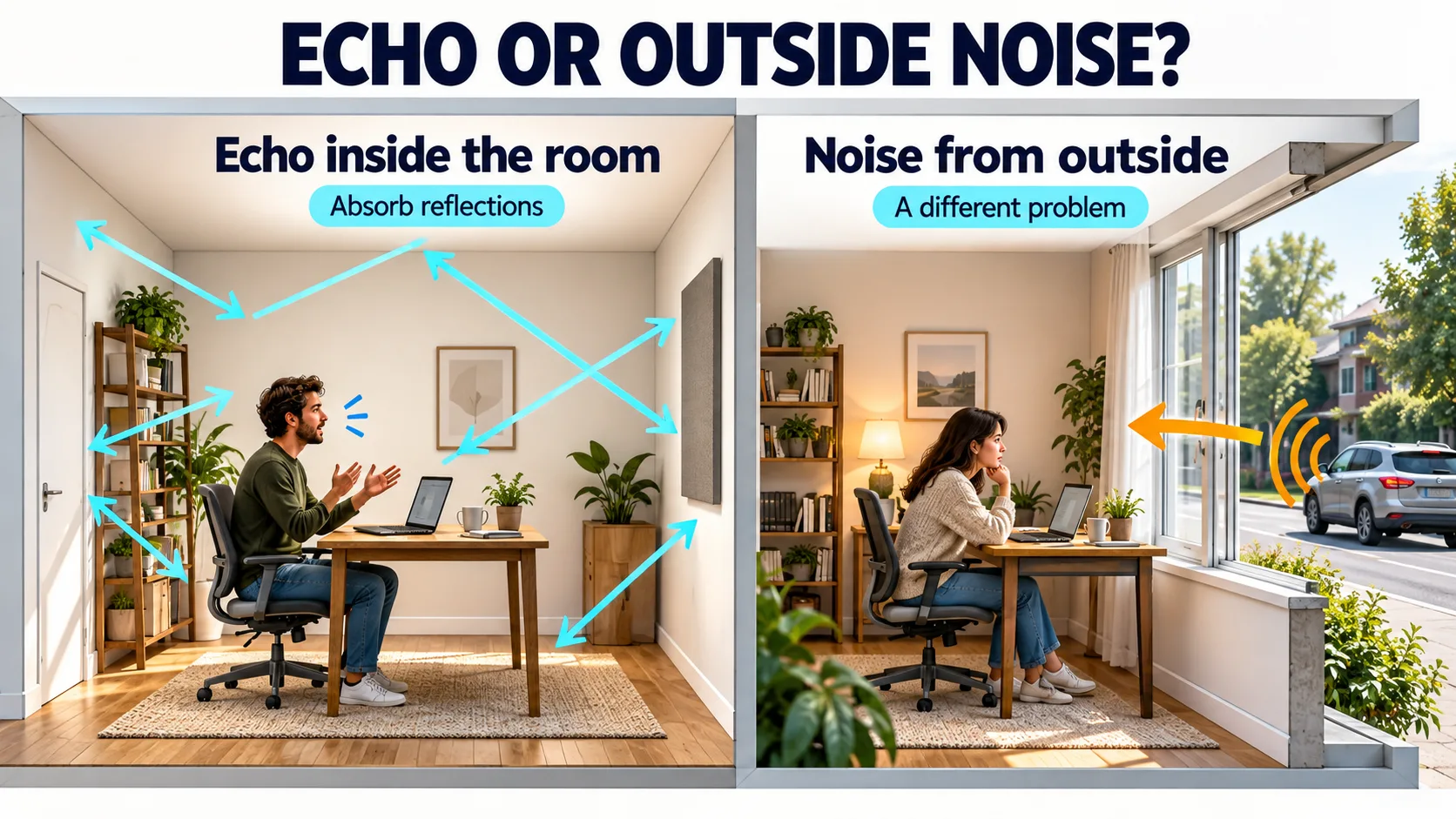
Concept illustration: reflections within a room and noise entering from outside require different approaches. Arrows are schematic, not a measured sound-path model.
Try these free changes before buying anything
Record the same short sentence at your usual desk position. Close existing curtains, bring in a spare rug or a thick blanket, and repeat with the same microphone position and settings. Listen for a shorter, clearer decay rather than simply a quieter recording.
For calls, move the microphone closer within the manufacturer’s recommended working distance. Adjust input level to avoid clipping. This can improve the balance of your direct voice against the room sound; turning gain down alone does not change the room’s acoustics.
If you want to learn how to reduce echo in a room on a budget, change one thing at a time. Keep the change that makes an audible difference before ordering a whole treatment kit.
What to buy to reduce echo in a room
These three examples address different reflective surfaces. They are not a bundle everyone needs, and their product listings are not independent proof of acoustic performance.
UMIACOUSTICS 2-inch panels: target bare wall reflections
The selected black four-pack uses fabric-wrapped fiberglass. The listing specifies 23.6 × 11.8 inches per panel and 2-inch thickness, with mounting hardware. Four panels provide approximately 7.7 square feet (0.72 m²) of face area, calculated from those dimensions.
This is the most targeted option here for a desk surrounded by exposed walls. GIK’s acoustic-treatment guidance explains how absorbers control reflections. Its guidance supports the treatment approach; it is not a test of these Amazon panels.
Check the wall fixing method and installation instructions. The listing’s “soundproof” wording should not be read as a promise to block neighbors or traffic. We have not verified a laboratory absorption report for this exact four-pack.
NICETOWN velvet curtains: cover a large exposed window
The selected black pair is 52 × 84 inches per panel, made from polyester velvet with grommets. Together the panels have 104 inches of flat fabric width. Allow enough width for folds when measuring your curtain rod; stretched-flat fabric and fully gathered curtains are different arrangements.
Consider them when a large glass surface remains uncovered and you also want privacy or light control. They are furnishings with potential acoustic benefit, not a substitute for purpose-made broadband absorbers. The listing describes light dimming rather than guaranteed 100% blackout without an added liner.
We have not verified an acoustic test report for this curtain set. Do not translate its noise-reduction marketing into a promised percentage reduction in room reverberation.
nuLOOM Marlow shag rug: add a soft floor covering
The selected white Marlow rug measures 5 × 8 feet and is listed as a polyester shag rug with non-slip backing. It adds a substantial soft surface where a hard floor is otherwise exposed. It is not sold here as a certified acoustic treatment.
Buy it if the floor needs a rug anyway, not because a rug alone will silence the room. Check floor compatibility, cleaning instructions and washer capacity. A shag surface may also make an office chair harder to roll; place it thoughtfully rather than automatically beneath the casters.
AVAILABLE ON AMAZON · AFFILIATE LINKS
Choose the purchase for your room
Compare the exact dimensions, mounting method, color, seller and return terms. International redirects may offer a local match; check it against the product discussed here.
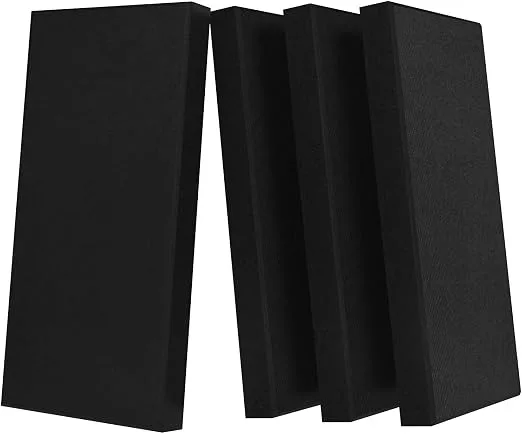
UMIACOUSTICS — four 2-inch acoustic panels
Check options on Amazon →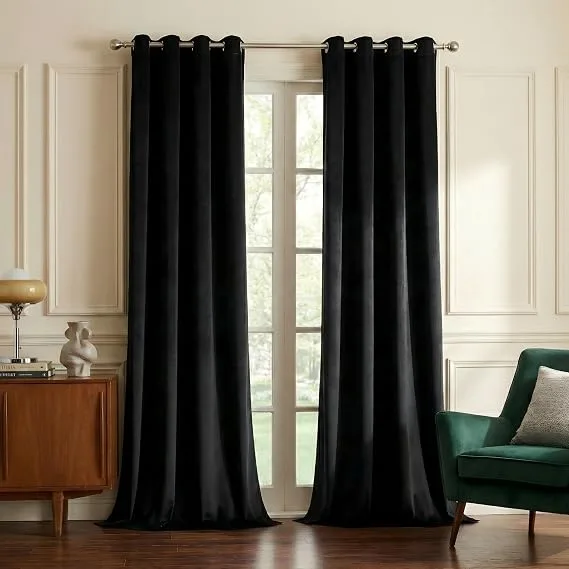
NICETOWN — black velvet curtains, 52 × 84 in
Check options on Amazon →
nuLOOM Marlow — white shag rug, 5 × 8 ft
Check options on Amazon →As an Amazon Associate, Decively earns from qualifying purchases, at no additional cost to you.
Place treatment where it can help
When working out how to reduce echo in a room, think about the area around the person speaking and the microphone. Start with exposed nearby walls and glass; do not concentrate every panel in one decorative corner.
Spread wall absorbers across useful reflection areas around speaking height, following their mounting instructions. Curtains must cover the glass when you need their effect. Keep exits, heaters and ventilation clear; landlord permission may be needed for drilled fixings.
Room size, ceiling height, existing furniture and the treatment’s absorption all affect the amount needed. Acoustimac’s coverage guidance uses surface area and room dimensions, rather than a universal panel count. A four-pack of small panels is a starting purchase, not a guaranteed whole-room solution.
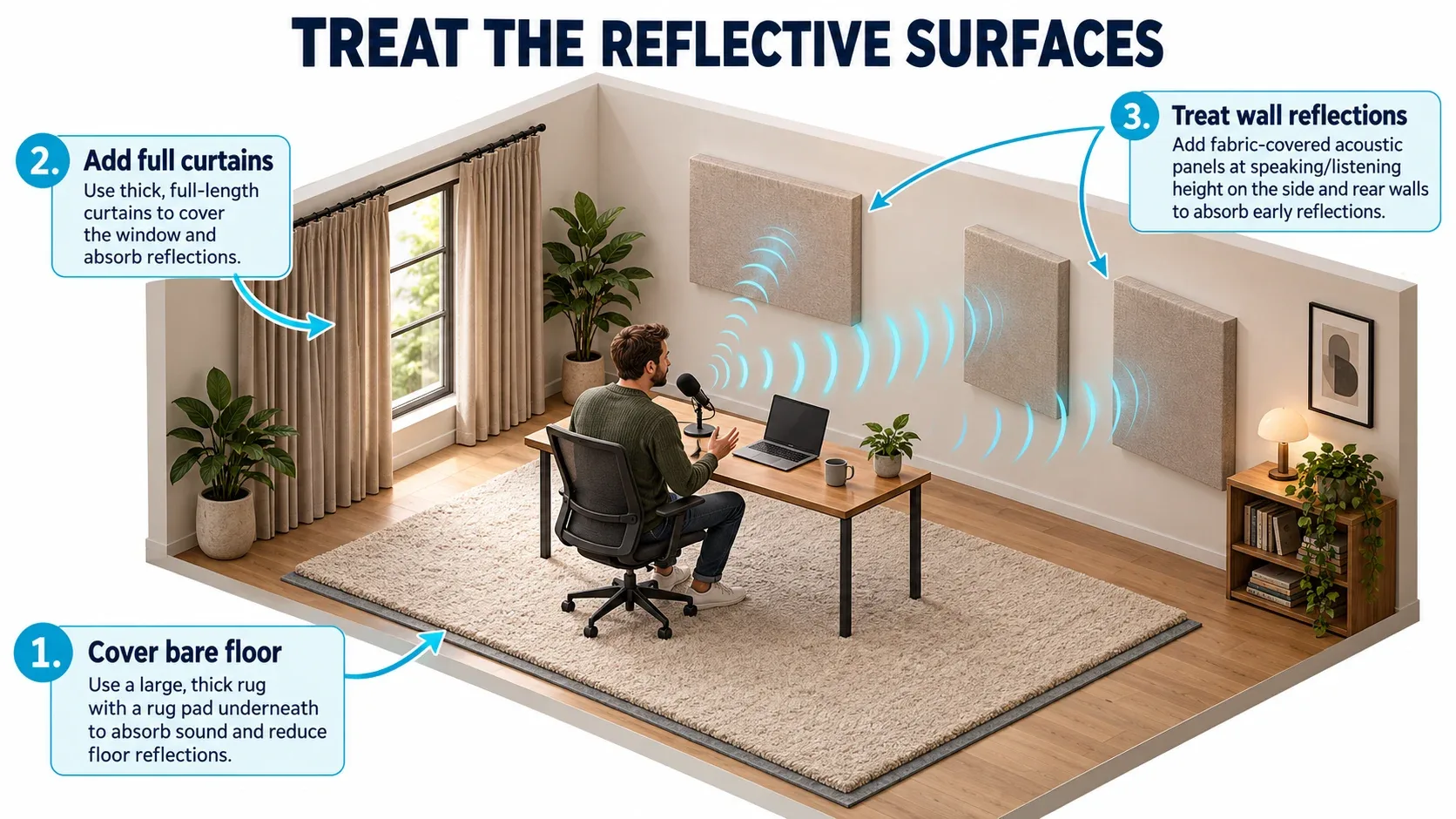
Illustrated placement principles, not a prescription for every room. Furniture and panel locations should be adapted to your layout and installation requirements.
Avoid paying for claims that do not solve your problem
NRC concerns absorption, not sound isolation. Ask for the test report, tested thickness and mounting configuration before relying on a headline rating. Thin decorative foam is not automatically equivalent to a thicker tested absorber, and treatment for speech should not be mistaken for a bass-control plan. See Acoustimac’s acoustics glossary for the distinction.
For renters, start with curtains, a rug and existing soft furniture. Use freestanding treatment if drilling is not allowed; do not assume adhesive strips can safely hold a heavy panel. For persistent, serious acoustic problems, seek a room-specific assessment.
How to reduce echo in a room: the sensible buying order
The best way to decide how to reduce echo in a room is to diagnose the sound, compare a repeatable recording, and treat the largest useful bare surface first. Then listen again. The aim is understandable speech and a comfortable room, not covering every surface or buying all three products.
If the room is mainly used for video calls, clear audio is one part of the setup. Our guide to improving webcam lighting covers the visual side without changing your room’s acoustics.
Sources and how we chose
Selection is based on the treatment type, published dimensions and practical installation requirements. Product specifications come from the linked Amazon listings; acoustic performance for these exact products was not independently tested by Decively.
GIK Acoustics — absorption and reflections
Acoustimac — treatment coverage
Acoustimac — acoustic terms and NRC
Shure — acoustic echo cancellation