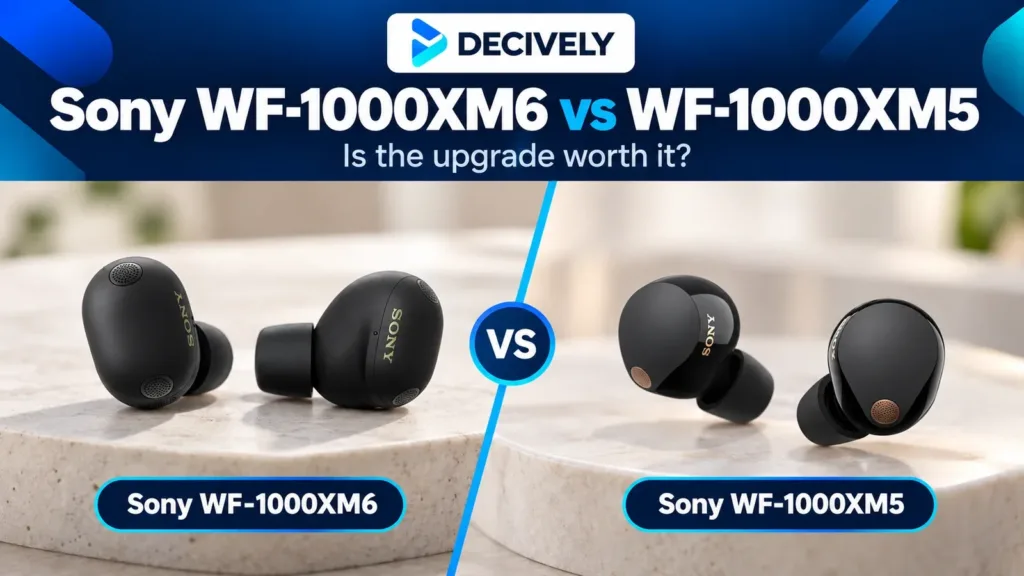

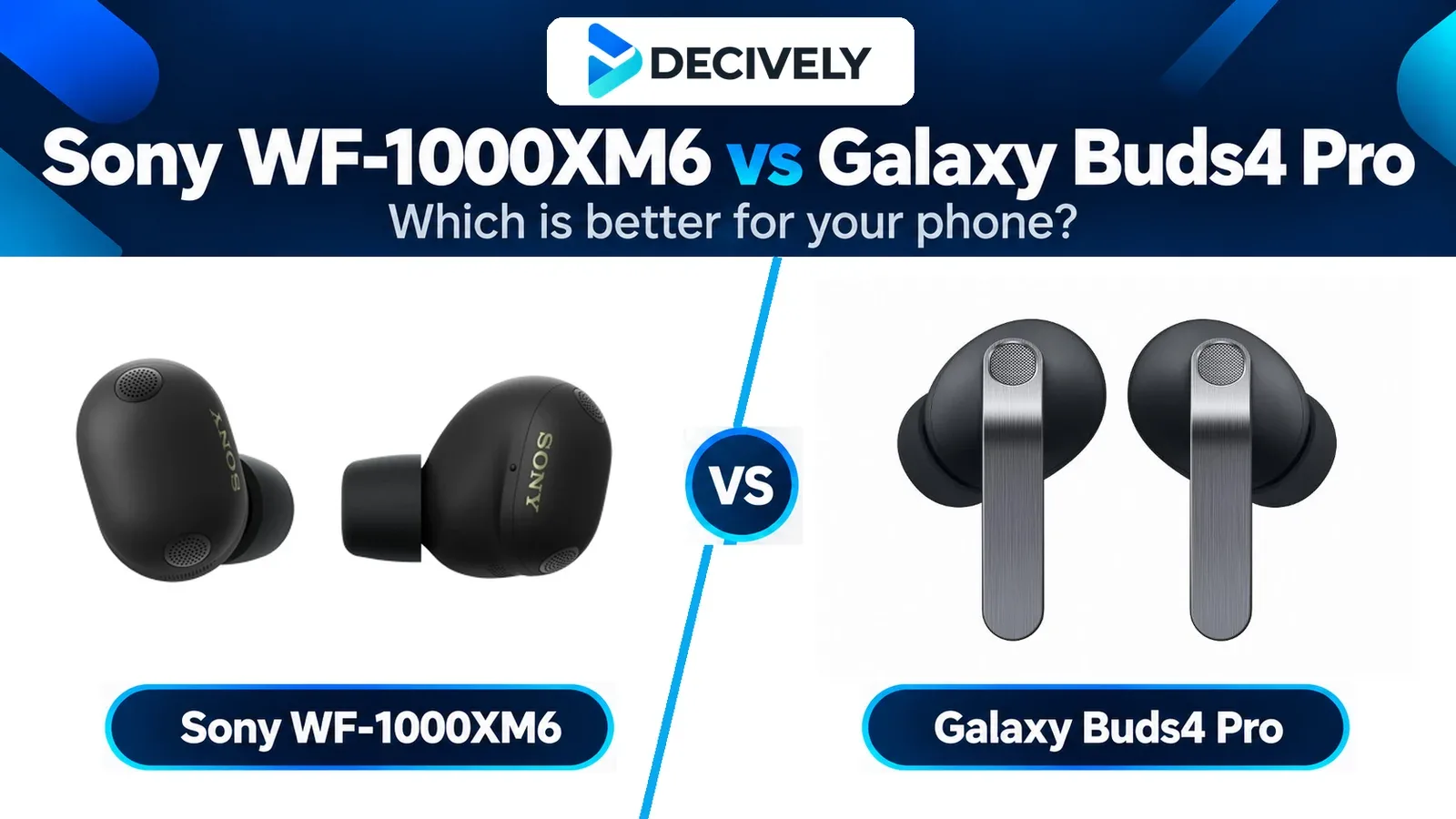
The Sony WF-1000XM6 vs Samsung Galaxy Buds4 Pro decision starts with your phone and the other devices you use. Both are premium 2026 earbuds. The useful question is which features you can actually use—not which specification sheet has the biggest numbers.
Quick verdict: choose for your actual setup
Choose Sony WF-1000XM6 for longer uninterrupted listening, an iPhone or non-Samsung Android phone, and phone/laptop multipoint. Choose Galaxy Buds4 Pro for a compatible Galaxy setup, a lighter fit and Samsung-specific controls—especially when the price gap is substantial. A Galaxy phone does not rule out Sony: battery life and mixed-device work can still matter more.
As an Amazon Associate I earn from qualifying purchases. Affiliate disclosure.
Amazon.com listings: standalone Black Sony WF-1000XM6 and Black Galaxy Buds4 Pro. Confirm the selected model, condition, seller, warranty and delivery eligibility before buying.
Your phone is the first filter

Generated editorial illustration of device setups, not photographs of named products or a Decively compatibility test.
Sony’s LDAC advantage applies only to devices that support it. An iPhone uses AAC over its built-in Bluetooth connection; buying Sony does not unlock LDAC on it. The iPhone benefit is app access and device flexibility.
Samsung currently requires Android 12 or later and at least 1.5GB RAM for Buds4 Pro app configuration. Head gestures require a supported Galaxy device with One UI 8.5 or later; AI, translation and advanced calling depend on device, software, region and service support.
Auto Switch is not general-purpose multipoint. Sony’s two-device connection lets one device wait for calls while another plays music; it does not mix two music streams into one.
Battery life: Sony has the clearer advantage
The laboratories use different methods, so their results are not interchangeable promises. Both support the same buying conclusion: Sony lasts longer between interruptions. Samsung’s larger case-inclusive claim does not mean longer playback in your ears. Volume, settings, codec and battery age affect actual runtime.
ANC and calls: the tests do not name one universal winner
SoundGuys and RTINGS favour Sony for noise isolation. However, Tom’s Guide reviewer Erin Bashford preferred Samsung in her office and traffic listening. A lab result and an individual fit are different evidence; do not assume either pair will remove every voice or keyboard click.
For calls, SoundGuys reports stronger Sony performance outdoors and in wind, while Tom’s Guide calls the comparison a draw. Samsung’s Super Wideband calling also requires supported Galaxy hardware and network conditions. Neither a microphone count nor an ANC score guarantees how you will sound on a work call.
Fit and sound can outweigh the spec sheet
RTINGS found Samsung more comfortable and stable. That is a reason to consider it for long wear, not proof that Sony will fit badly. Sony supplies four tip sizes; an effective seal affects both bass and noise isolation.
Sound preference is less settled than battery life. Bashford preferred Samsung’s bass-forward presentation; RTINGS describes both as warm. Use their EQ options before treating a reviewer’s favourite tuning as your own. More codec support is useful flexibility, not proof of better sound on every phone.
When is Sony worth paying more for?
Pay more for Sony when you regularly exceed a six-hour listening session, need ordinary phone-and-laptop multipoint, or want app control while using an iPhone. Those benefits remain useful if you later change phone brands. Skip the premium if you mostly listen briefly on one Galaxy device and Samsung fits better.
When is Samsung the better buy?
Choose Samsung when its current offer is meaningfully lower, its stem design suits your ears and your Galaxy devices support the features you want. At similar prices, weigh Sony’s endurance and flexibility against Samsung’s fit and integration rather than buying by brand alone.
Compare the same condition and seller warranty. Neither an old launch-price gap nor a renewed-versus-new offer is a fair comparison. These are Amazon.com listings: delivery, import costs and local warranty arrangements can differ outside the US.
Using an iPhone and considering Apple’s alternative? Our AirPods Pro 3 vs Pro 2 comparison explains that ecosystem’s upgrade decision.
Research notes
Researched October 15, 2026. Decively has not tested these earbuds. Specifications and compatibility come from the manufacturers; test results and listening impressions are attributed to the named publications. Conflicting findings are retained, not averaged into a Decively score. Current Amazon prices and ratings are not reproduced.
Sony: WF-1000XM6 specifications
Sony: app, wearing guidance and multipoint setup
Sony launch announcement and battery footnotes
Samsung: current phone requirements and feature restrictions
Samsung: official Buds4 Pro specifications and battery claims
Adam Birney, SoundGuys: comparative battery, ANC and call tests
RTINGS: direct Sony-versus-Samsung comparison
Erin Bashford, Tom’s Guide: contrasting hands-on findings