
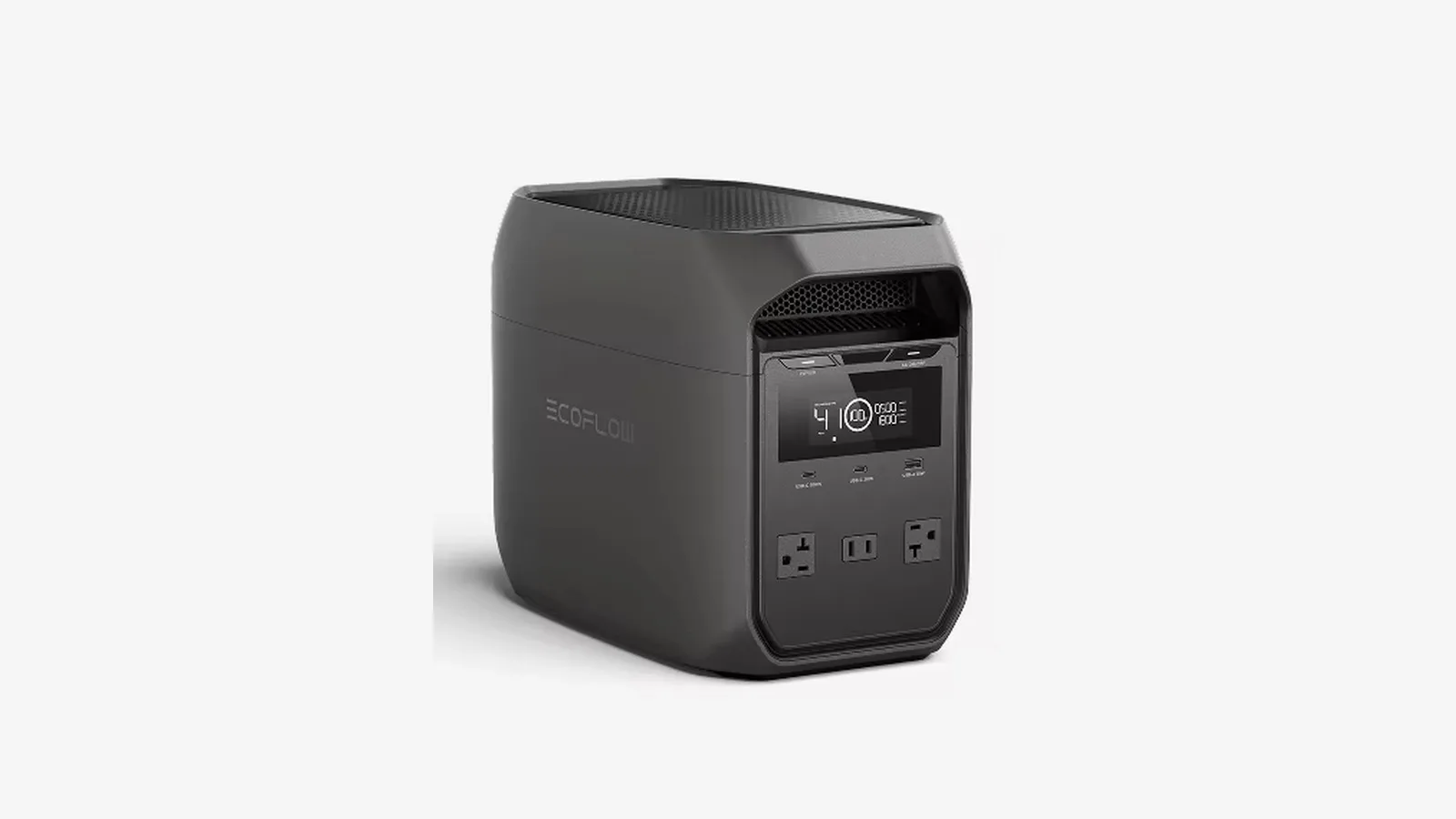
The Best Portable Power Station for a home that wants backup without calling an electrician is not always the model the listing leads with. The EcoFlow DELTA 3 Classic is a 1,024Wh LiFePO4 portable power station with three AC sockets, an 1,800W inverter and a switchover fast enough to sit between your wall socket and your desk as an uninterruptible power supply. In the entry 1kWh class, it belongs on your shortlist.
This is a research-based review of published specifications, EcoFlow’s own documentation and the supplied seller listing. Decively has not hands-on tested this unit, and no figure below is a Decively measurement.
What makes the best portable power station for most homes
Before any specification sheet, it is worth saying what the best portable power station actually has to get right, because the marketing rarely leads with it. Four things decide whether you are still happy in two years: the battery chemistry, the inverter rating, how fast the unit recharges, and whether it can take over the moment the grid drops.
Chemistry comes first. A LiFePO4 pack is rated for thousands of charge cycles where the older lithium chemistry managed a few hundred, which is why nearly all of the best portable power stations sold today use it. The inverter rating decides what you can run at once. Recharge speed decides whether the unit is useful again between two outages on the same day. And switchover time decides whether it can sit permanently in line as a backup supply, or whether it is something you plug in after the lights have already gone out. Get those four right and you are most of the way to the best portable power station for your situation.
A fifth criterion is what separates the best portable power station from a merely good one, and almost nobody checks it before ordering: whether you can add capacity later. That is exactly where this model makes a deliberate compromise, and it gets a section of its own further down.
Measured against those five points the DELTA 3 Classic scores well on four, which is a strong result at this end of the market. The best portable power station for a home office is the one that gets all five right for the way you will actually use it, so the rest of this review works through each point using the seller’s own material, then states plainly where the unit falls short.
What the DELTA 3 Classic actually is
Strip away the marketing and three decisions define this model. The cells are LiFePO4 rather than the older lithium chemistry, which is why EcoFlow can quote 4,000+ cycles instead of the few hundred that early power stations managed. That single specification is the difference between a device you keep for a decade and one you replace in three years. The inverter is rated at 1,800W continuous. And the charging circuit accepts up to 1,400W from a wall socket, which is what makes the quoted 0–80% in 45 minutes possible.
The word Classic matters. EcoFlow sells a DELTA 3 and a DELTA 3 Plus alongside this one and they are not the same machine, as the section on expansion below explains. Anyone comparing the best portable power station options inside a single brand gets caught by this, so check the exact model name on the listing before you order.
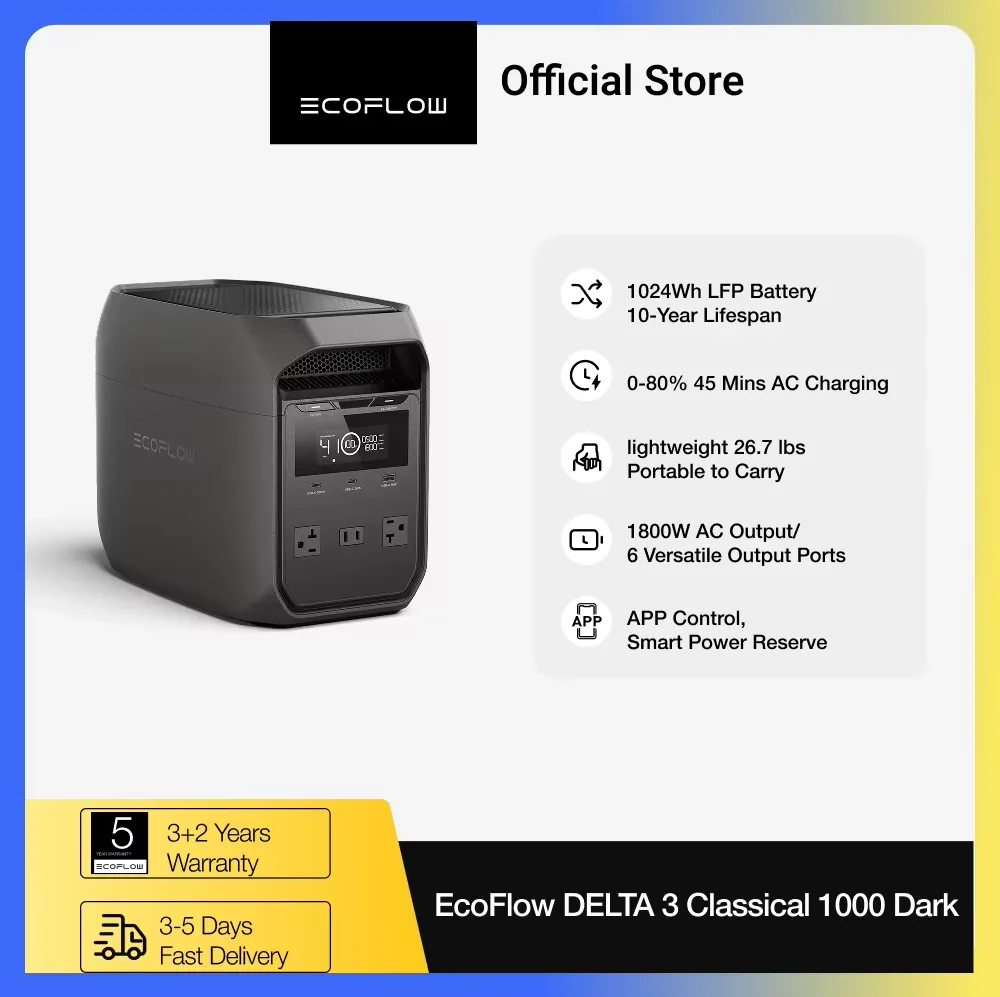
Seller listing summary. These headline figures come from the listing and the manufacturer, not from Decively testing.
1,800W covers a home office, and some of a kitchen
1,800W continuous with a 3,600W surge is enough for a desk setup several times over: a desktop PC, two monitors, a router and a network drive together rarely exceed 400W. This is the first number to check when you compare the best portable power station candidates, because the inverter rating rather than the battery size decides what you can switch on at all. It also covers a microwave, a kettle or a small space heater, one at a time. What it will not do is run several of those together, and it will not reliably start a large motor-driven appliance such as a well pump or a table saw unless you have checked that tool’s startup draw against the surge rating first.
The port count is where this model is deliberately simpler than its siblings. You get three AC sockets, two USB-C ports rated at 100W and 30W, and one 18W USB-A port, for six outputs in total. Count the sockets before you order, because the best portable power station on paper is no use if it cannot feed everything you want running at the same time. The 100W USB-C is worth planning around: charging a laptop over USB-C skips the AC inverter entirely and wastes noticeably less of the battery than plugging its wall adapter into an AC socket.
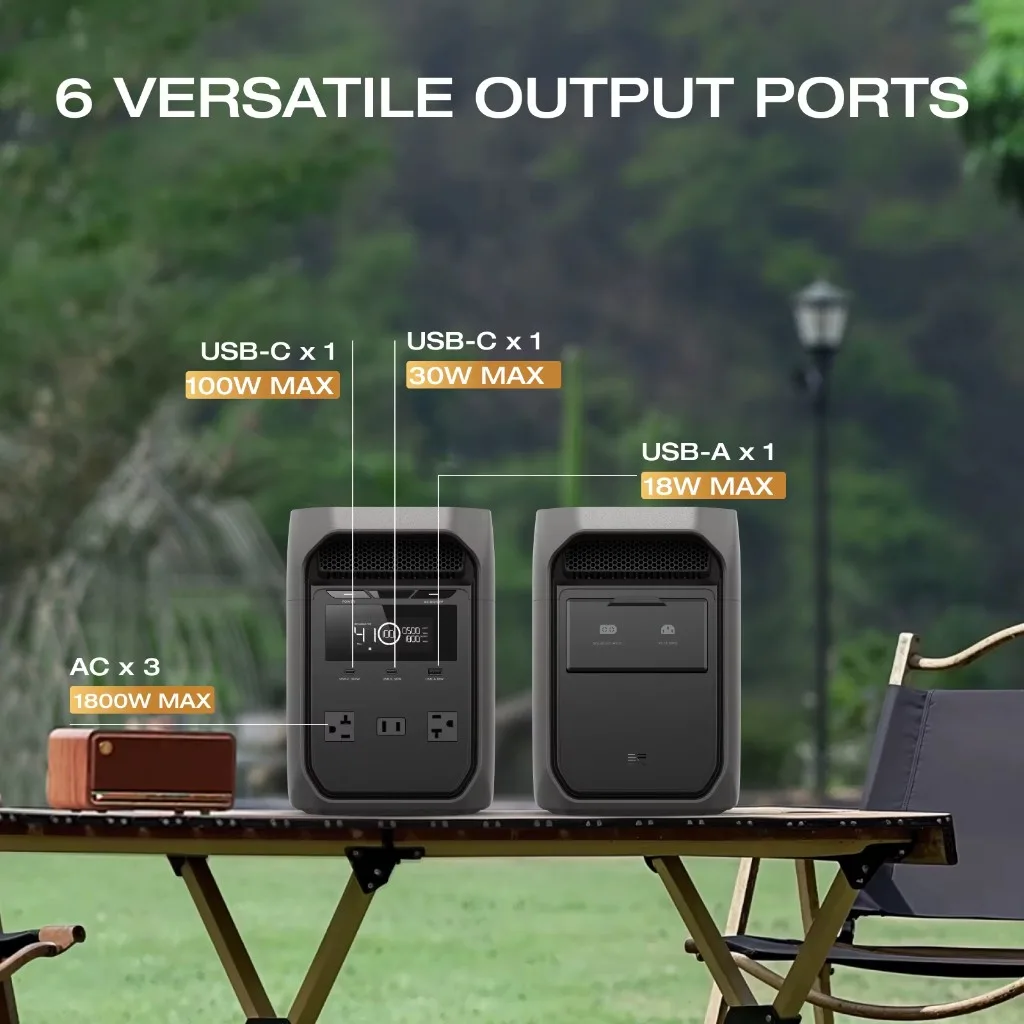
The seller’s own port diagram. Count them: three AC, two USB-C, one USB-A. There is no 12V car socket in this layout.
The switchover is the feature that earns its keep
Plug the DELTA 3 Classic into the wall, plug your equipment into the DELTA 3 Classic, and it behaves as an uninterruptible power supply. EcoFlow rates the switchover at under 10 milliseconds, which is below the gap at which a desktop PC, a network drive or a router typically drops out.
This is the part of the product most buyers underrate, and it is the single feature that moves this unit from a camping battery to a genuine candidate for the best portable power station in a home office. A dedicated UPS with comparable capacity is a single-purpose box that lives under your desk forever. This does that job, then unplugs and comes camping. If you work from home and have ever lost an hour of work to a brownout, the backup function alone may justify the purchase more than the outdoor photography the listing sells it on.
One caveat worth stating plainly: the 10 ms figure is a manufacturer specification, not something we measured. For genuinely critical equipment, such as a home server with a RAID array mid-write, test the behaviour with your own hardware before you rely on it.
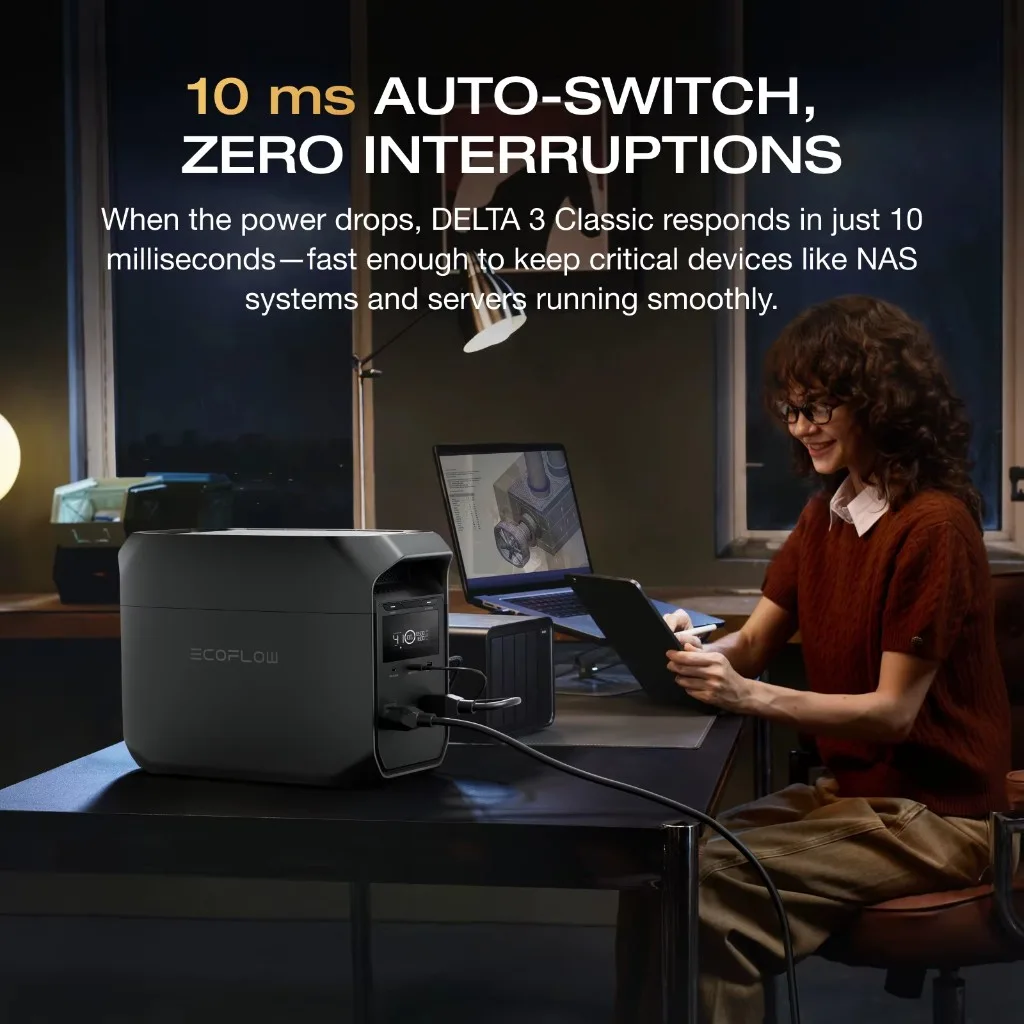
Seller illustration of the backup scenario. The 10 ms figure is EcoFlow’s specification, not a Decively measurement.
30 dB is real, but read the asterisk
EcoFlow quotes 30 dB, roughly the level of a quiet library, and noise is the specification most people forget to check when they shortlist the best portable power station. The listing image carries an asterisk and prints the condition right underneath it: that figure applies when the unit is powering under 600W. Below that load the fans can stay slow or stopped. Push the inverter towards its 1,800W ceiling, or fast-charge the battery at 1,400W from the wall, and the fans become audible.
This is worth knowing rather than a reason to avoid the unit. It means the DELTA 3 Classic is genuinely quiet in the scenario most people buy it for, which is running a desk or a few lights overnight, and noticeably less so when it is working hard. The practical takeaway is simple: if the unit will live in a bedroom or a small office, do your fast charging during the day. For that use the best portable power station is the one that stays quiet at low load, not the one with the lowest number in the brochure.
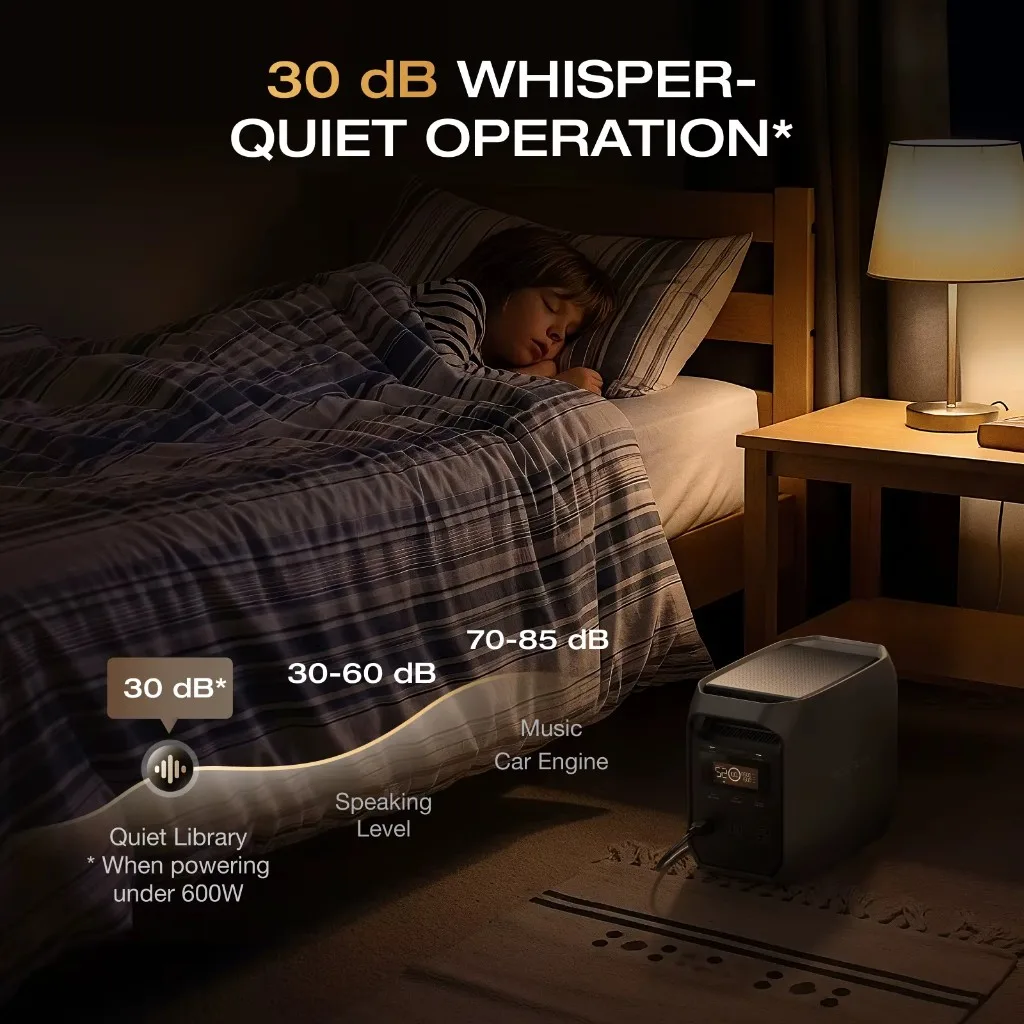
The asterisk is in the seller’s own image: 30 dB applies when the unit is powering under 600W.
Portable in the two-hands sense
26.7 lb, or 12.1 kg, in a box measuring 15.7 × 7.9 × 11.1 inches. That is light for the capacity and the moulded handles make it manageable, but set expectations honestly: this is a load you carry from the car to the campsite, not one you walk a trail with. That is normal rather than a criticism, because the best portable power station in this capacity class will always weigh something. The cells are the weight.
For home use the footprint is the more useful number. It is narrow enough to sit beside a desk or inside a cupboard without reorganising the room, which matters if the unit is going to live permanently plugged in doing backup duty rather than coming out twice a year.
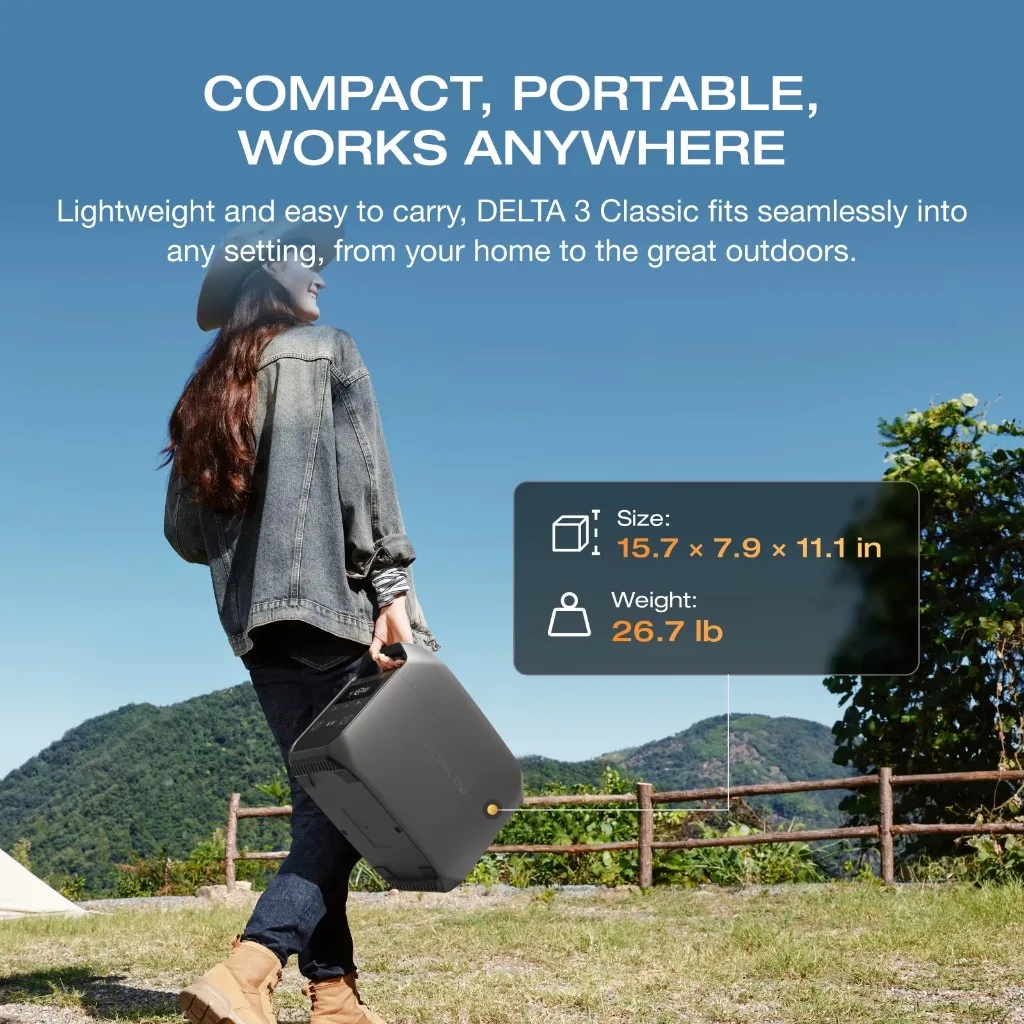
Seller image. At 26.7 lb the unit is carryable, but it is a deliberate lift rather than something you sling over a shoulder.
The app is where backup planning actually happens
Software is the quiet difference between the best portable power station and a plain battery in a box, and the EcoFlow app adds three things worth understanding before you buy. Storm alerts watch the local forecast and top the battery to full before severe weather arrives, which is the difference between facing an outage with a full battery and discovering it was sitting at 40%. Self-Powered Mode prioritises solar input over grid charging. Scheduled tasks let you set charging and discharging windows, which is how you use the unit to shift consumption into cheaper off-peak hours.
These are cloud-connected features running on a server you do not control. They work well today and they are a genuine part of the value, but treat their long-term availability as a reasonable expectation rather than a contractual guarantee, as with any connected device. The hardware works without them.
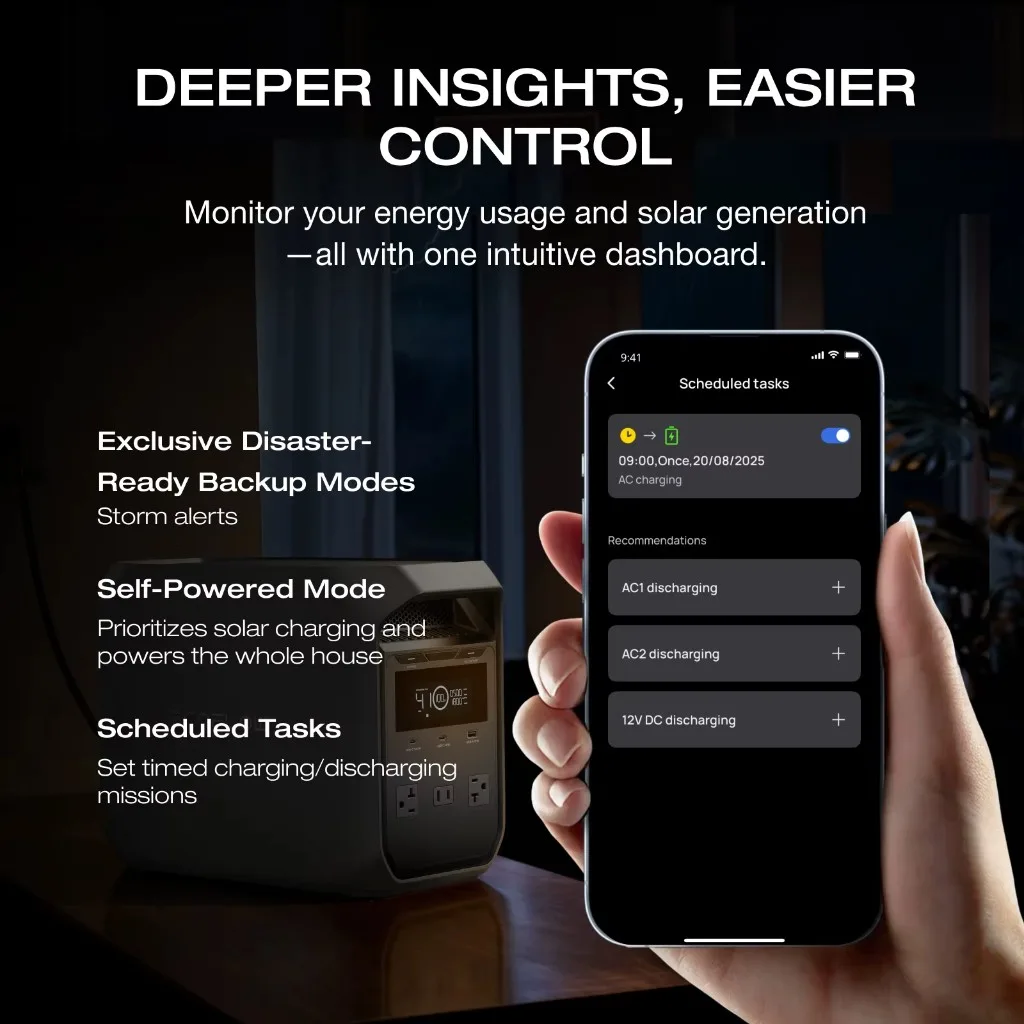
Seller illustration of the EcoFlow app. Storm alerts and scheduled charging are the two features worth checking before you buy.
Key specifications at a glance
Figures are taken from EcoFlow’s published specifications and the supplied seller listing. Listing-only claims are labelled as such. Nothing here has been independently measured by Decively.
Specification
DELTA 3 Classic
Battery
1,024Wh LiFePO4 (LFP)
Cycle life
4,000+ cycles to 80% capacity; listing claims a 10-year lifespan
AC output
1,800W continuous, 3,600W surge
AC sockets
3
USB-C ports
2 — one at 100W, one at 30W
USB-A ports
1 at 18W
Total output ports
6
12V car socket
Not part of this port layout — confirm before ordering
Extra-battery port
Not available on the Classic; DELTA 3 and DELTA 3 Plus are the expandable models
Backup switchover
Under 10 ms (EcoFlow specification)
AC charging
Up to 1,400W; listing quotes 0–80% in 45 minutes
Solar input
Up to 500W
Weight
26.7 lb / 12.1 kg
Dimensions
15.7 × 7.9 × 11.1 in
Noise
Listed at 30 dB when powering under 600W
App features
Storm alerts, Self-Powered Mode, scheduled charging and discharging
Warranty
Listing states 3+2 years; confirm what the extra two years require
The limitation that is easy to miss
Here is the thing the listing will not put in a headline: the DELTA 3 Classic does not take an extra battery. For a certain kind of buyer that single fact rules it out of being the best portable power station for their situation, no matter how good the rest of the sheet looks.
EcoFlow’s DELTA 3 and DELTA 3 Plus both have an expansion port and can be paired with an add-on battery to reach several kilowatt-hours. The Classic cannot. What you buy is what you have, permanently. 1,024Wh will run a 100W desk setup for roughly eight hours on paper and rather less in practice once inverter losses are counted. For an overnight outage that is comfortable. For a two-day outage in which you also want to keep a fridge cold, it is not, and there is no upgrade path.
The second omission is the 12V car socket. The port layout is three AC, two USB-C and one USB-A, with no 12V DC output for car-style accessories such as a 12V cooler or a tyre inflator. If that is part of your plan, this is the wrong model in the range.
Neither of these is a defect. They are how EcoFlow keeps this model cheaper than its siblings, and for most buyers neither will matter. But they are the two reasons people send a power station back, so decide on them before you order rather than after it arrives. The best portable power station is simply the one whose compromises you can live with for the next decade.
Where to buy it
The button below goes to the AliExpress listing this article was written around. One habit is worth keeping on any marketplace, and especially when you are comparing the best portable power station deals across several sellers: ignore the struck-through “original” price. Those anchors are routinely set at a level the product has never actually sold for, which makes the discount percentage printed next to them meaningless. Compare the live price against EcoFlow’s own store on the day you buy, and factor in shipping, import charges and who would handle a warranty claim if the unit failed.
ALIEXPRESS OFFER
Check today’s EcoFlow DELTA 3 Classic offer
1,024Wh LiFePO4 · 1,800W AC output · Under-10 ms backup switchover
Prices on this listing change frequently, so we do not quote one here. Confirm the current price, shipping, tax, import charges and returns at checkout.
Affiliate link: Decively may earn a commission at no additional cost to you.
So is it the best portable power station for you?
Worth shortlisting if you want a home-office backup supply that also works as a camping and outage battery, and if 1,024Wh covers the loads you actually have in mind. Judged on chemistry, charge speed and switchover, it has a real claim to being among the best portable power station choices in its capacity class, and those three specifications are the ones doing the work.
Look elsewhere if you expect to grow the system later, because the Classic cannot take an extra battery; if you need a 12V car socket; or if your outage planning involves keeping a fridge running for more than a day. In those cases the DELTA 3 or DELTA 3 Plus is the best portable power station in EcoFlow’s own range for you, and the extra outlay buys capability you will genuinely use rather than a bigger number on the box.
Whichever you choose, read the model name on the listing twice before you pay. “DELTA 3 Classic” and “DELTA 3” are one word apart and a meaningful difference in what arrives, and the best portable power station on paper is worth nothing if a different model turns up at the door.
Sources
EcoFlow DELTA 3 Classic official product page · EcoFlow DELTA 3 series comparison
Product images, listing specifications and the offer link were supplied for this article. Manufacturer claims were checked against EcoFlow’s published pages and are attributed as claims throughout.