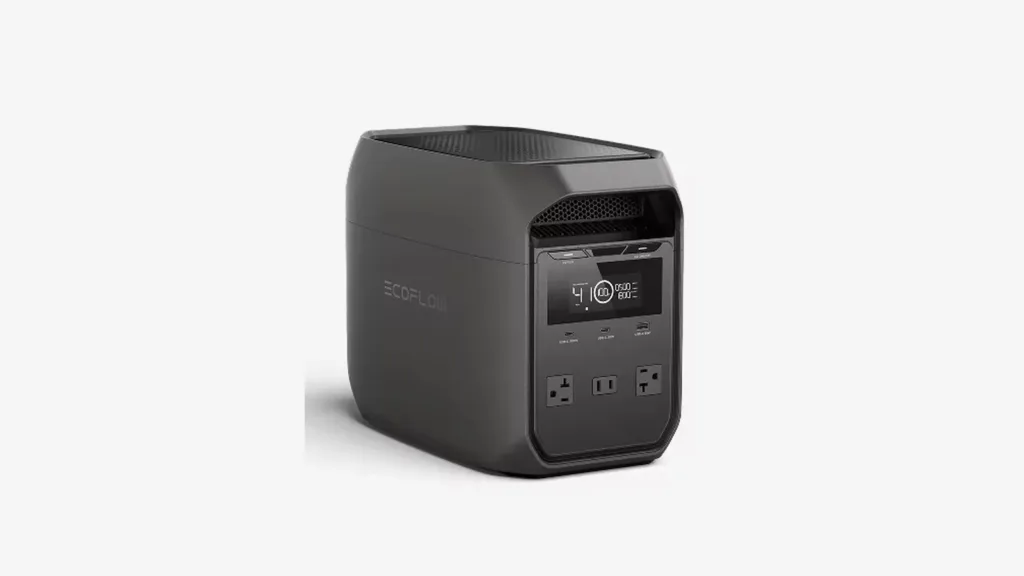

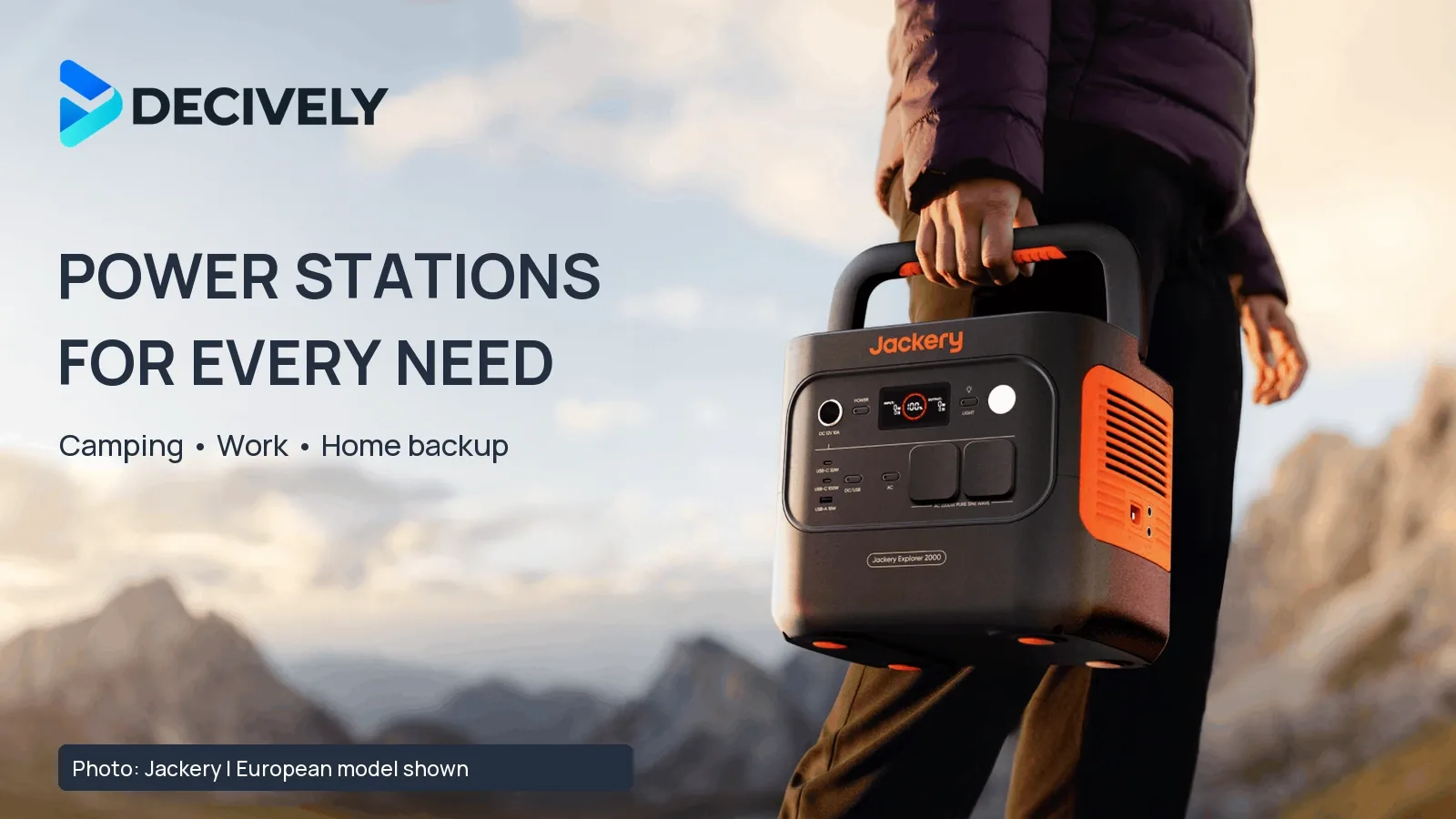
Cover photo: Jackery Explorer 2000 v2 (European model). © Jackery / PR KONSTANT. Specifications below refer to US versions.
Quick picks: match the power station to the job
For most people who need AC sockets, start with the Anker SOLIX C1000 Gen 2. Choose C300 DC for USB charging, RIVER 3 Plus for light camping, Explorer 2000 v2 for longer essentials backup, or DELTA Pro 3 when higher output and capacity justify its size.
These are research-based picks for five common needs, not a claim that one model wins every test. Decively has not tested these stations. The best portable power stations are the ones sized for your actual devices, carrying limits and current budget.
As an Amazon Associate I earn from qualifying purchases. Affiliate disclosure.
Amazon links originate from US listings and may redirect to a local store. Check the exact model, bundle and voltage on the destination page; the table below uses US specifications.
USB-C workdays and device charging
Anker SOLIX C300 DC
For laptops, phones and compatible 12V gear. No AC sockets; a wall charger is not included.
Light camping with AC sockets
EcoFlow RIVER 3 Plus
For lamps, chargers and modest AC loads. Its 286Wh battery limits long appliance runs. Local redirects may select RIVER 3 Max Plus Wireless instead; check the variant.
Camping, a home office and short outages
Anker SOLIX C1000 Gen 2
Our all-round starting point: 1,024Wh and 2,000W AC. Capacity cannot be expanded.
Longer outages and multi-day car camping
Jackery Explorer 2000 v2
More stored energy without a 100lb unit. Still 39.5lb, with no battery expansion.
Higher-output backup and compatible RV setups
EcoFlow DELTA Pro 3
4,096Wh and 4,000W output. At 113.5lb, plan where it will stay.
The numbers that change the decision
Watts (W) tell you what can run; watt-hours (Wh) tell you how much energy is stored. Continuous output must cover the devices running together. Motor-driven equipment also needs sufficient startup headroom. Capacity alone cannot tell you whether a fridge or tool will start.
Why we would choose each model
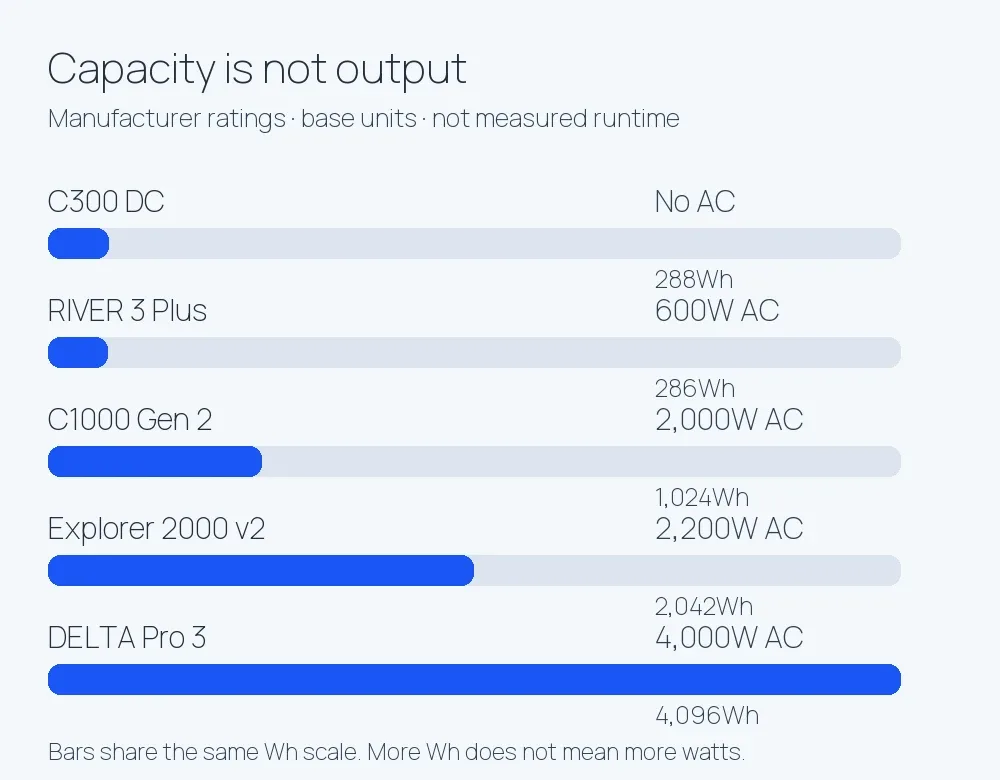
Manufacturer-rated base capacity and continuous output. The C300 DC has no AC inverter; the chart is not a runtime benchmark.
Anker SOLIX C300 DC: usb-c workdays and device charging
This is the pick for a USB-first setup, not for household plugs. Anker specifies two bidirectional USB-C ports rated up to 140W each, with 300W shared across its outputs. Check your laptop’s USB-C charging requirements and use an appropriate cable.
The Gadgeteer’s hands-on review found recharging less convenient without a suitable high-power USB-C charger. That is the extra cost to check before buying. Choose the C300 DC specifically; the AC-equipped C300 is a different product.
EcoFlow RIVER 3 Plus: light camping with ac sockets
Choose this when you want a small station but still need a household socket. EcoFlow’s manual rates the 286Wh RIVER 3 Plus at 600W continuous AC. Optional EB300 or EB600 batteries can increase capacity; this guide compares the station alone.
PhoneArena measured a one-hour mains recharge in its review. The same reviewer’s winter solar test took around three to four hours with a 160W panel, showing why advertised solar times depend on conditions. Use it for light campsite loads, not prolonged cooking or heating.
The Amazon title’s 760W refers to combined output across ports, not 760W of AC power: EcoFlow’s manual specifies 600W continuous AC and 760W total output. X-Boost is not equivalent to a higher continuous AC rating. This distinction matters when sizing an appliance.
Local-match check: this link redirected to RIVER 3 Max Plus Wireless on Amazon UK during our check. That is a different variant; confirm RIVER 3 Plus and its regional specifications before buying.
Anker SOLIX C1000 Gen 2: camping, a home office and short outages
This is where we would start for mixed use: a home office during an outage, a powered campsite, or occasional higher-wattage appliances. Anker specifies 1,024Wh, 2,000W continuous AC and a 24.9lb weight. That balances carrying effort against useful power better than a much larger unit.
Android Authority’s hands-on reviewer used the Gen 2 for remote work and camping, and reported under-an-hour mains charging. Anker’s faster 49-minute figure requires UltraFast mode in its app. Those are different kinds of evidence, not a Decively benchmark.
The trade-off is fixed capacity: Gen 2 does not accept an expansion battery. Also check the exact generation. Some comparison pages mix original C1000 specifications with Gen 2 figures. If the existing EcoFlow option is substantially cheaper, read our DELTA 3 Classic buying guide before deciding.
Jackery Explorer 2000 v2: longer outages and multi-day car camping
Choose the Explorer 2000 v2 when battery capacity matters more than the smallest carrying size. Jackery specifies 2,042Wh and 2,200W continuous AC, with a 39.5lb weight. That is roughly twice the C1000 Gen 2’s stored energy, not twice its output power.
OutdoorGearLab measured 1,710Wh of usable AC energy from its test unit. That matters more for planning than assuming every nameplate watt-hour reaches your appliances. Runtime still depends on the load and test conditions.
It suits selected essentials over a longer outage or a campsite cooler and electronics, once their actual energy use is checked. It is not expandable, and continuous electric heating can drain even this battery quickly. Select 2000 v2, not 2000 Pro or 2000 Plus.
EcoFlow DELTA Pro 3: higher-output backup and compatible rv setups
The DELTA Pro 3 is for buyers whose measured loads justify a larger system. EcoFlow specifies 4,096Wh, 4,000W total AC output and 120/240V capability for the US model. Compatible extra batteries add capacity, but cost, space and connection requirements grow with the system.
OutdoorGearLab measured 3,790Wh of usable energy from its test unit. Its weight is the bigger everyday compromise: EcoFlow lists 113.54lb. Wheels help on suitable surfaces; they do not turn it into an easy carry up stairs.
Choose it for demanding backup or RV loads only after checking startup draw, total simultaneous load and the relevant socket. It is not an automatic promise to power an entire home. Connecting to household circuits requires a compatible transfer system and qualified installation.
How long will a portable power station last?
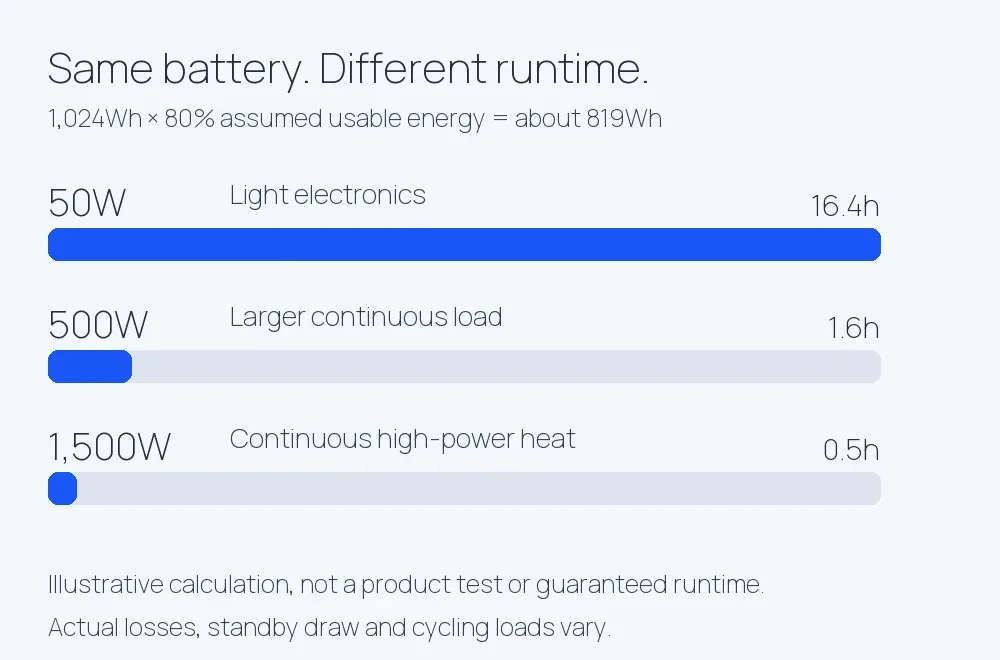
Original Decively calculation using a stated 80% usable-energy assumption. These are illustrative continuous loads, not measured results.
A practical starting estimate is capacity × assumed usable fraction ÷ average load. For a 1,024Wh station with an illustrative 80% usable fraction, that is about 16.4 hours at 50W, 1.6 hours at 500W, or 33 minutes at 1,500W. Actual efficiency and idle consumption vary; 80% is a planning assumption, not a specification shared by these five models.
This is why buying a station that can run a heater does not mean it can heat a room all night. Fridges cycle on and off: measure energy over time rather than dividing by their peak wattage. Leave a reserve instead of planning to empty the battery completely.
Before you order: four checks worth making
1. Region: these picks use Amazon.com listings and US specifications. Confirm the correct voltage, frequency, plugs, delivery and local warranty. A plug adapter does not convert a US 120V station into a UK/EU 230V model. Amazon’s local matching may lead to a different product or bundle.
2. The bundle: compare station-only prices with station-only prices. Solar panels and expansion batteries are optional unless the selected package says otherwise. Match solar-panel voltage, current and connector to the station; the headline panel wattage is not guaranteed real-world input.
3. Outage operation: a quoted UPS/EPS transfer time is not a blanket guarantee that every computer or appliance stays running. Check the manual’s supported loads and bypass limits, and test your own setup before relying on it.
4. The connection: plug compatible devices into the station. Never feed its output into a household wall socket. Household circuit backup needs the proper transfer arrangement and qualified installation.
Two buying questions, answered
Is a solar generator different from a portable power station? In these listings, it usually means a power station sold or used with solar panels. The base unit stores energy; a panel is needed to recharge it from sunlight. Check exactly what is included.
Which power station is best for a refrigerator? There is no safe universal answer from capacity alone. Check your fridge’s startup demand and measured daily energy. The C1000 Gen 2 is a short-outage starting point; the Explorer 2000 v2 and DELTA Pro 3 offer more stored energy if your measured requirements justify it.
Our recommendation: buy the capacity you will use
Start with the C1000 Gen 2 for mixed AC use. Step down to C300 DC or RIVER 3 Plus if your needs are smaller; step up to Explorer 2000 v2 or DELTA Pro 3 when measured runtime or output needs demand it. Compare current prices for the correct US variants rather than buying on a temporary discount percentage.
See our Buying Guides for more decision checklists. Research checked October 7, 2026. Official specifications come from Anker, EcoFlow and Jackery; firsthand reports are attributed to The Gadgeteer, Android Authority, PhoneArena and OutdoorGearLab. Recommendations and runtime illustrations are Decively editorial analysis.