
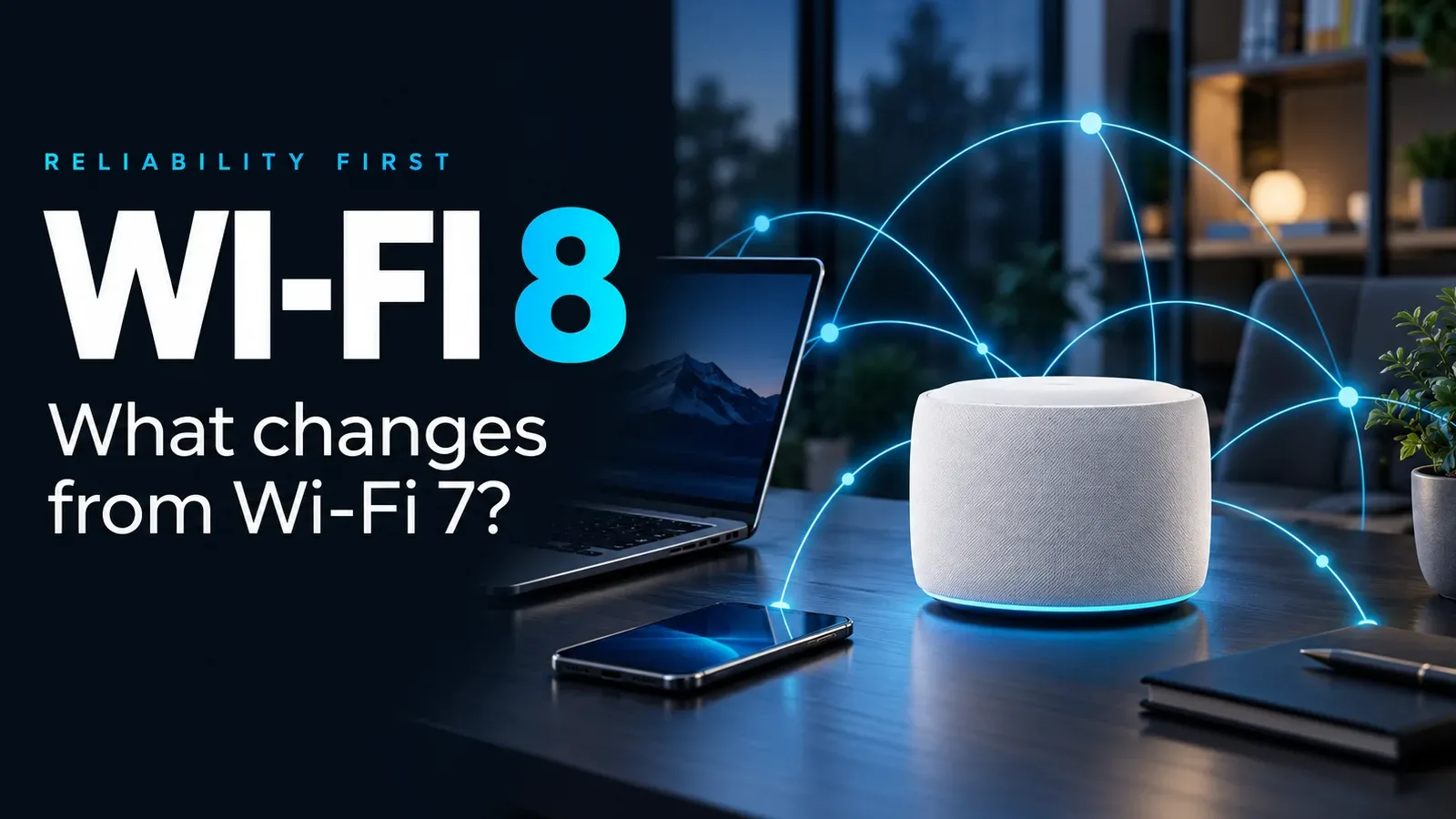
Wi-Fi 8 is coming, but the most useful change may be how consistently your connection works when conditions get difficult. Think crowded networks, a video call while walking between rooms or a laptop near the edge of coverage.
The short answer: this next generation is being developed around Ultra High Reliability. It is not a finished standard or a reason to assume every current router has become obsolete. Here is what the announcements mean, how it compares with Wi-Fi 7 and whether you should wait.
Research-based explainer, not a hands-on Wi-Fi 8 test. Official IEEE, Wi-Fi Alliance and chipmaker sources checked October 11, 2026. Roadmaps and draft features can change.
What is Wi-Fi 8?
Wi-Fi 8 is the name used for the forthcoming generation based on IEEE 802.11bn. Its UHR focus addresses the gap between an impressive connection speed and a connection that delivers data dependably under load.
A speed test mostly tells you how much data moved during the test. A call or online game also depends on latency—how long data takes to arrive—and jitter, the variation in that delay. Lost packets and interruptions during roaming can matter even when your download speed looks healthy.
The goal is to improve that everyday delivery. A higher peak speed on a box, by itself, does not tell you whether an important packet arrives on time.
Wi-Fi 8 release date: what is confirmed?
There is no single worldwide release date. Chip announcements, retail hardware, certification and final IEEE approval are separate milestones.
January 2026: MediaTek announced its Filogic 8000 family at CES, saying its first chipset was expected to reach customers later in 2026. That is a supplier roadmap, not confirmation that certified consumer routers are widely available.
2028: Qualcomm’s current overview projects Wi-Fi Alliance certification in January. Treat that as a vendor projection rather than a guaranteed launch date.
May 2028: the IEEE task group’s September 2026 timeline schedules final RevCom/SASB approval for this month, following working-group approval in March. These are planned milestones; the standard remains under development.
If you see an early Wi-Fi 8 device advertised, check exactly what is shipping, which draft features it supports and what its certification status is. “Announced” does not mean a complete, interoperable ecosystem is ready.
Wi-Fi 8 vs Wi-Fi 7: what actually changes?
Wi-Fi 7 already improves reliability and latency. Its Multi-Link Operation lets compatible devices use multiple links, while 320 MHz channels and 4K QAM support higher throughput. Those very wide channels depend on local 6 GHz availability and compatible equipment.
The Wi-Fi 8 vs Wi-Fi 7 distinction is therefore about extending dependable performance in challenging situations. It is misleading to describe one generation as “speed” and the other as the first to care about reliability.
Do not translate draft demonstrations into a promised percentage improvement for your home. Router design, client support, interference and placement all affect the result.
Where Wi-Fi 8 could make a useful difference
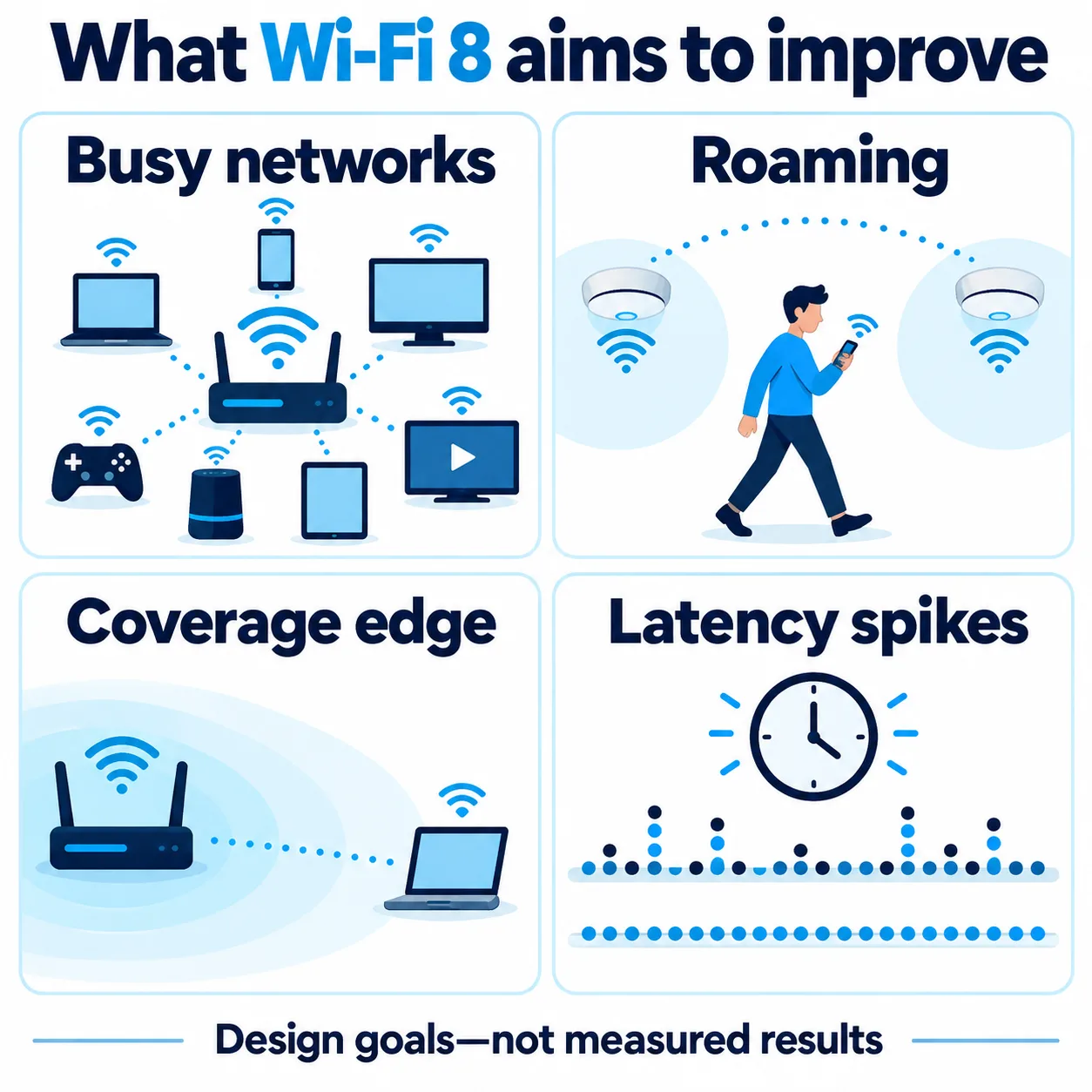
Conceptual illustration of development goals, not measured improvements or guaranteed coverage.
Busy networks: better coordination could help when many devices compete for airtime. A faster internet plan alone does not solve contention on the wireless network.
Moving between access points: improved roaming aims to reduce interruptions while your phone changes its connection. This matters more in multi-AP homes, offices and public networks than beside a single router.
Coverage edges: proposed changes target useful performance under weaker signal conditions. That is not a promise to overcome every concrete wall or make placement irrelevant.
Delay-sensitive tasks: reducing occasional long delays could be useful for calls, gaming and interactive applications. A network with fewer sudden stalls can feel better even without a dramatic download-speed increase.
How cooperating access points could help
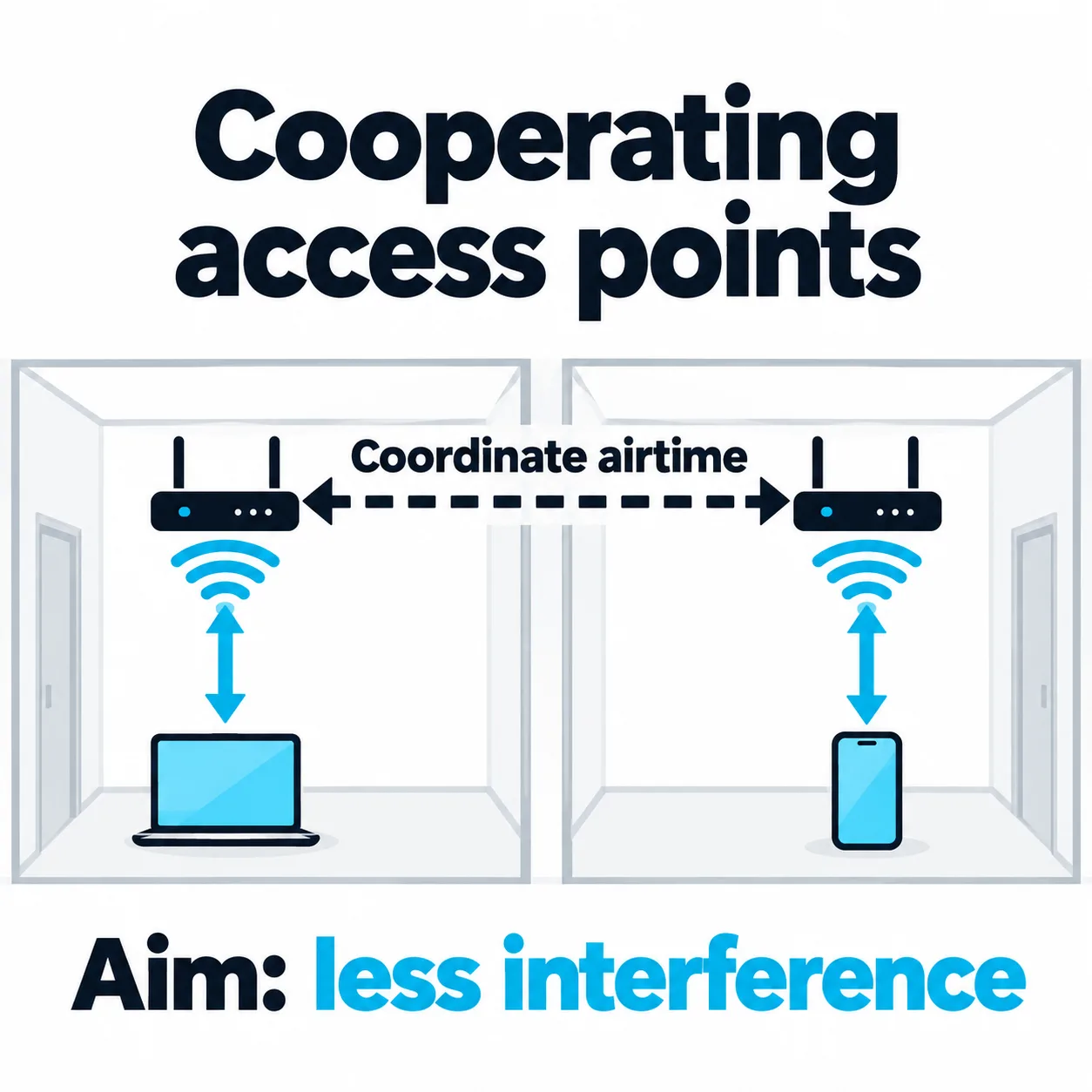
Illustration of cooperating access points. It does not mean your router can manage every neighboring Wi-Fi network.
MediaTek describes proposed techniques including Coordinated Spatial Reuse, Coordinated Beamforming and multi-AP scheduling. In plain language, participating access points can coordinate how they use the wireless medium instead of operating entirely independently.
Other proposed mechanisms improve channel access and handling of competing radios inside a device. These are technical tools for delivering data more efficiently; the exact feature set and real-world benefit will depend on the finished implementation.
Will your existing devices work with Wi-Fi 8?
Qualcomm describes backward compatibility with Wi-Fi 7 and earlier generations. That means older devices can remain useful on a future network, subject to the router’s supported bands and configuration.
It does not turn an older laptop into a next-generation client. Some network-level improvements may help mixed networks, but features requiring support at both ends need compatible equipment. Do not assume a firmware update will transform any Wi-Fi 7 router into Wi-Fi 8 hardware.
Should you buy Wi-Fi 7 now or wait?
Our view: fix an actual problem now if it disrupts your work. Start by identifying whether the bottleneck is your internet service, router placement, interference or the connection between mesh units.
For a room that keeps dropping out, our guide to fix weak Wi-Fi explains what to check before buying. A carefully placed access point or suitable wired backhaul can be more useful than waiting for a new generation.
Wi-Fi 7 is worth considering when its features match your devices and workload. If your current setup is dependable, keep it while the next ecosystem matures. Wait for independent testing, clear certification and prices before treating Wi-Fi 8 as a necessary upgrade.
For Europe and the US, check regional model specifications and permitted bands. Certification does not make spectrum rules identical across countries, and a new router cannot exceed the limits of your broadband service.
The takeaway
The interesting question in Wi-Fi 8 vs Wi-Fi 7 is how the network behaves when conditions get messy. Better coordination, roaming and delivery consistency could be more valuable than another headline speed figure. For now, it is promising technology under development—not a proven fix for every home network.
Primary references
IEEE 802.11 Task Group bn — current progress and approval timeline
Qualcomm — Wi-Fi 8 overview, compatibility and certification projection
Qualcomm — Ultra High Reliability, roaming and coordination
MediaTek — January 2026 Filogic announcement and proposed technologies
Wi-Fi Alliance — original Wi-Fi CERTIFIED 7 announcement