
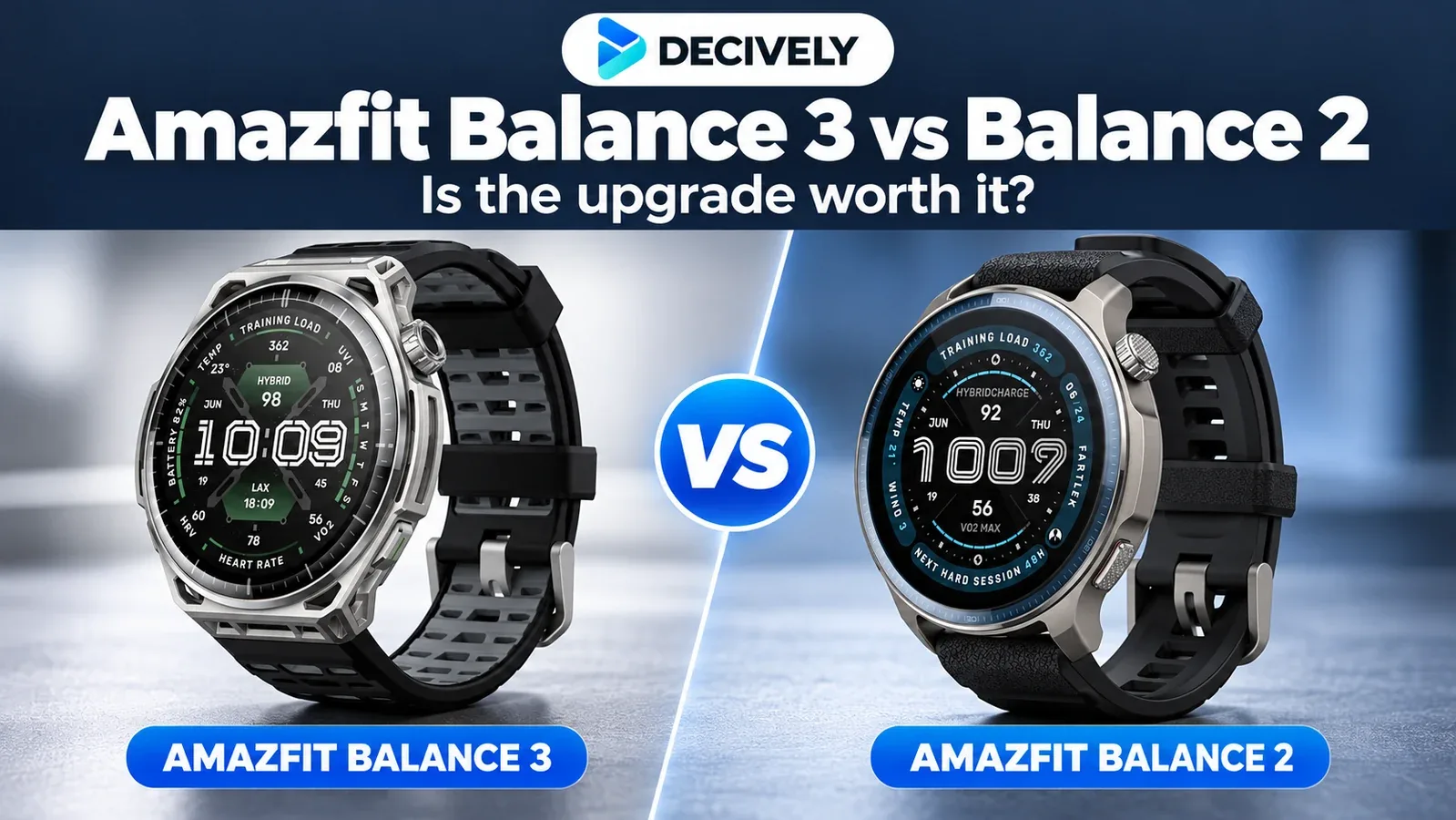
The Amazfit Balance 3 vs Balance 2 decision is closer after the older watch's software updates. Pay for hardware you will use, rather than treating every launch feature as exclusive to the newer model.
Quick verdict: hardware upgrade or better value?
Choose Balance 3 for the LED flashlight, extra buttons, brighter display and longer claimed GPS endurance. The Stainless Steel version suits someone comfortable with a noticeably larger, heavier watch.
Choose Balance 2 when a meaningful discount and lower weight matter more. It already offers sapphire glass, dual-band GPS, maps and updated hybrid-training tools. Existing owners should update it before deciding to replace it.
As an Amazon Associate I earn from qualifying purchases. Affiliate disclosure.
Balance 3 vs Balance 2: the useful differences
The Amazon title calls Balance 3 "48mm", but Amazfit's current US and UK sheets give a 51.4mm case diameter. Use that actual measurement for fit. The Stainless Steel model has steel framing and parts with a reinforced-polymer shell; it is not the lighter, all-titanium edition.
The screen does not get larger or sharper. Higher peak brightness and physical controls are the practical upgrades; the extra weight is the compromise.
Software: update Balance 2 before paying for Balance 3
Amazfit's July 2026 Balance 2 update added HybridCharge, Next Hard Session recovery guidance and more HYROX templates and strategy tools. August's update brought Zepp OS 6, Training Calendar and Training Library. June had already added offline route planning. These published updates supersede reviews claiming Balance 2 lacks that software.
Both can combine training, sleep and recovery information in Zepp. This guidance can help organise workouts, but it is not a medical assessment or a precise measurement of your body's remaining energy. Check installed firmware rather than assuming every update has reached your watch.
GPS and maps: newer does not automatically mean more accurate
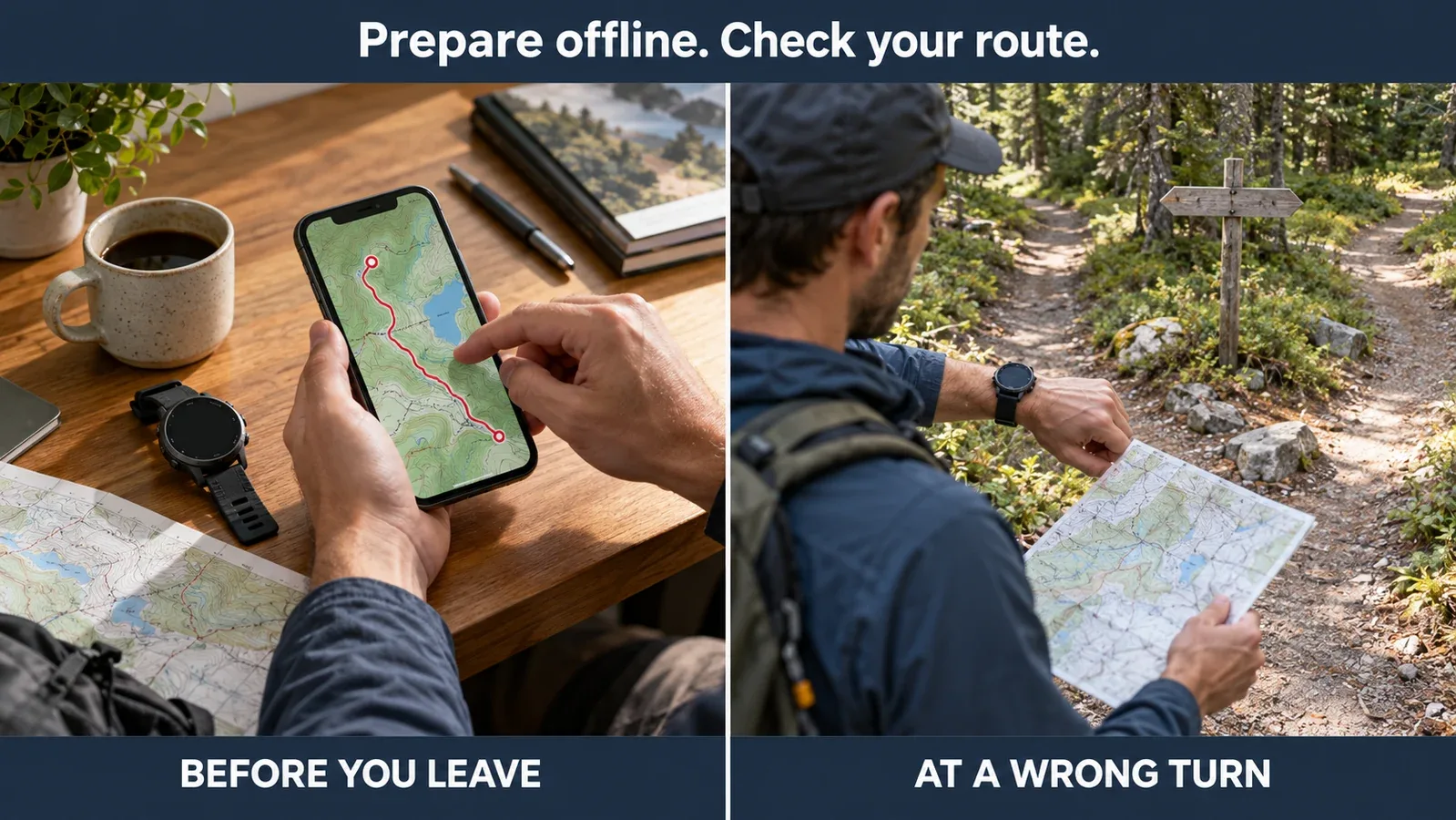
Illustration of offline-route preparation and checking a wrong turn, not an actual Zepp screen, GPS test or photograph of a named watch.
The independent results are mixed. The5krunner scored Balance 3 at 77 versus Balance 2 at 85 on his standard 10-mile route; his Stockholm run was more competitive. Those are his route-test scores, not universal percentages of accurate GPS fixes. Gadgets & Wearables found only around 30–40 metres difference from a Garmin across two 7.5km runs. Different routes, firmware and protocols prevent a simple winner.
Both provide offline mapping. Download the correct area and prepare your route before leaving. Balance 3 advertises automatic rerouting, but The5krunner reported unreliable visual route updates after wrong turns. That observation is firmware-dependent; do not buy on the assumption that unfamiliar-route navigation is flawless.
Golf Monthly's Balance 3 tester, a year-long Balance 2 user, found golf menus and map responses quicker. He still sometimes had to correct the selected hole. Better interaction can justify an upgrade for frequent map users without proving better GPS accuracy.
Heart-rate accuracy: useful tracking, not a sensor-generation leap
Both list BioTracker 6.0. Gadgets & Wearables' steady run returned 144bpm average on Balance 3 against 146bpm on a Garmin watch; that is an optical-watch comparison, not an ECG reference. The5krunner used chest references and found strong gym/cycling results but drift or dropouts on some runs and weaker swim results.
If intervals or training zones are the priority, consider pairing a compatible Bluetooth chest strap with either watch. The case upgrade alone is not evidence that Balance 3 will track every workout more accurately.
Battery life: the clearest gain is in long GPS sessions
Everyday claims are unchanged. Balance 3's longer GPS figures matter more for long hikes or events than for a few short weekly workouts. Its up-to-84-hour power-saving figure uses single-frequency GPS; compare accuracy mode if route quality matters.
Independent use is less uniform than the headline: TechRadar's Paul Hatton reached about 21 days on Balance 2 with occasional workouts, dropping to roughly a week with AOD and more GPS. The5krunner described around 7–10 days of real-world Balance 3 use. These workloads differ and do not show Balance 3 losing a matched battery test.
Phone features and Zepp Pay: check the regional limits
The current sheets list Android 8/iOS 17 or newer for Balance 3, and Android 7/iOS 15 or newer for Balance 2; current Zepp app requirements also matter. Both support Bluetooth calls through a nearby connected phone. Neither offers standalone LTE. Android gets native reply options; do not expect the same messaging experience on iPhone. Zepp Flow availability depends on language and region.
Zepp Pay is not a worldwide payment promise. Amazfit documents supported European countries and the UK, participating issuers and Curve; the US, Canada and Australia are not on that published list. Confirm the exact regional watch, bank and card before buying for contactless payments. A US Amazon listing does not establish local payment eligibility.
Which offer makes sense for you?
Buy Balance 3 if you will regularly use the flashlight, extra controls or extended GPS runtime, and its size fits. Compare today's premium against those specific benefits. There is little reason to replace a working Balance 2 solely for the shared training software.
Buy Balance 2 if the saving is substantial and you want a lighter everyday fitness watch. The linked Aluminum Alloy configuration includes black and red silicone straps; both listings include a charging base without a USB-C cable. Check seller, condition, returns and delivery before comparing final cost.
For less expensive options, see our Best Value Smartwatches guide or Amazfit Active 2 review.
Research notes
Checked 14 October 2026. Decively has not physically tested these watches. This comparison separates Amazfit specifications and firmware notes from attributed independent testing. Reviewer scores and different battery workloads are not a controlled head-to-head test. Wellness estimates are not medical diagnoses.
The Amazon links select Balance 3 Stainless Steel (B0H383F5QN) and standard Balance 2 Aluminum Alloy (B0F9JFCYNX), not Balance Ultra, Titanium or Balance 2 XT. Product imagery: Amazfit; editorial composition: Decively. Maps illustration depicts generic situations, not actual Zepp screens or measured GPS results.
Amazfit — Balance 3 specifications and current software notes
Amazfit — Balance 2 specifications and June–August 2026 updates
Amazfit UK — Balance 3 navigation, GPS modes and regional caveats
Amazfit — Balance 3 and Balance Ultra launch
Amazfit — Zepp Pay countries, issuers and Curve
The5krunner — original Balance 3 GPS and heart-rate tests
Gadgets & Wearables — original Balance 3 running tests
TechRadar — original Balance 2 battery and usability review
Golf Monthly — Balance 3 tested after a year with Balance 2