
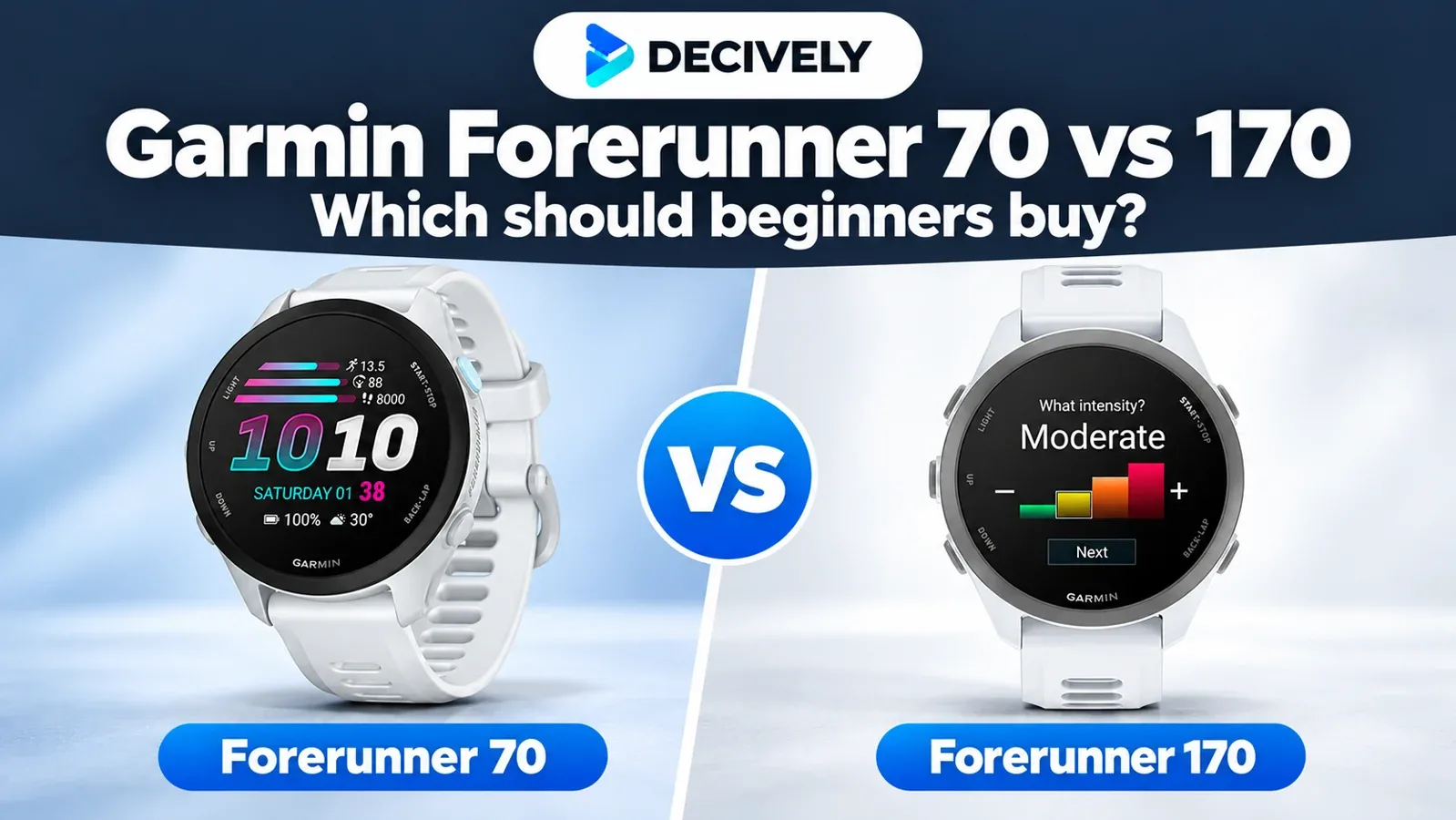
The Garmin Forerunner 70 vs 170 choice is about the extras you will use, not buying access to better beginner training. Both launched in May 2026; this comparison covers the new GPS-equipped 70 and the standard 170, with the separate Music edition explained where it matters.
Quick verdict: start with the 70 unless you need the extras
Choose Forerunner 70 for run/walk sessions, a first 5K or 10K, and regular road running. It already includes adaptive coaching, Training Readiness, Training Status and route following. If it costs meaningfully less, its longer claimed battery life makes it the practical starting point.
Choose Forerunner 170 for Garmin Pay, barometric elevation, a compass, open-water swimming or cycling power-meter support. The standard model linked here does not store music for phone-free listening; that requires the 170 Music.
As an Amazon Associate I earn from qualifying purchases. Affiliate disclosure.
The differences that change the buying decision
The screen and controls do not get bigger or fundamentally better on the 170. Both use compact polymer bodies, 20mm quick-release straps and chemically strengthened glass. Their 5 ATM rating supports swimming use; it is not a diving specification.
The linked 70 is Whitestone. The linked standard 170 is Whitestone/Cloud Blue. Amazon calls both 43mm; Garmin's precise case width is 42.6mm. Check the selected style as well as the colour before ordering.
What a beginner gets without upgrading to the 170
Both offer Garmin Coach's beginner-friendly run/walk plans, daily suggested workouts and quick workouts built around time and intensity. Training Readiness, recovery guidance and training-load information are already on the 70. You do not need the 170 simply to prepare for a longer race.
Use those estimates to organise training, not as medical advice or permission to ignore fatigue. Consistent wearing helps the watch build a recovery picture; buying the pricier model does not replace that history.
GPS and heart-rate accuracy: paying more is not the fix
Neither watch has dual-band GPS, and both use Garmin's Elevate Gen 4 optical heart-rate system. In DC Rainmaker's side-by-side testing, their GPS and heart-rate results were broadly alike. His deeper tests showed strong GPS tracks but occasional heart-rate errors, including cadence lock while filming and a missed section during cycling.
TechRadar's Mike Sawh found the 70 competitive with the 170 and 970, while noting shakier GPS around tall buildings and slower heart-rate response when easing off intervals. For precise interval heart rate, both can pair with a compatible external monitor; the 170 is not a sensor-generation upgrade.
Both follow synced courses with breadcrumb navigation. That means a route line, not a full street or topographic map underneath it. The 170's compass makes orientation more responsive, but does not add offline maps. Garmin's phone-linked Google Maps directions are a separate Android feature.
When the 170 earns its premium

Illustration of two running situations, not photographs of Garmin watches or GPS test results.
Wrist payments: useful for a drink after a run, provided your exact card is eligible for Garmin Pay. Bank participation varies by country and card; a Visa or Mastercard logo alone is not enough.
Hills and navigation: the barometric altimeter and compass are more useful when you regularly check ascent or direction. DC Rainmaker also found the 70 could show GPS-derived elevation information when following a loaded course, so saying it has no elevation information at all would be misleading.
Other sports: open-water swim tracking, cycling power-meter pairing and smart-trainer control can justify the 170. Neither watch has a dedicated multisport/triathlon mode. A cyclist or swimmer should check those requirements rather than assume the higher model covers everything.
Music: both linked models control music on a connected phone. Offline songs and supported service downloads require the separately sold 170 Music, Bluetooth headphones and, for some services, a subscription. Buying the standard 170 will not provide that upgrade.
Battery life: the cheaper model has the stronger claims
Compare the same GPS mode: Garmin quotes 23 versus 20 hours in GPS-only, and 16 versus 14 hours in all-systems. Neither figure promises that runtime with every feature enabled. Brightness, always-on display, workouts, notifications and connected sensors change consumption.
Independent experience varies. Tom's Guide reported about six days on the 70 with always-on display and regular wearing. TechRadar reported less than a week with AOD and outdoor runs, and nearly 10% drain during an hour in its best GPS mode. Those differing workloads do not establish one guaranteed battery result; they do make the 13-day headline a poor expectation for intensive use.
Phone compatibility and the final price check
Both work with compatible iPhone and Android phones through Garmin Connect, including notifications. Native text replies and notification-image viewing are Android features; Garmin Messenger has its own app requirements for both participants. LiveTrack and incident alerts need the compatible connected phone and service conditions. Neither is a standalone cellular or Bluetooth calling watch.
Compare today's offers on the exact styles. If the 170 is only slightly more and you will use its sensors or payments, it can be the better buy. If you carry your phone and mainly run roads, the 70 avoids paying for extras that will sit unused.
Considering an older Garmin at a discount? Read Forerunner 170 vs 165. For a broader shortlist, see Decively's best-value smartwatches guide.
Research notes
Checked 14 October 2026. Decively has not physically tested these watches. Manufacturer specifications and maximum battery claims are distinguished from attributed independent tests. Reviewers used different workloads; this is an editorial buying comparison, not a Decively laboratory test.
Amazon selections: Forerunner 70 Whitestone (B0H1F6H8FN) and standard Forerunner 170 Whitestone/Cloud Blue (B0H1F6BHG3). These are US-store links; local matching, selected variants, delivery and import costs may vary. Product photography: Garmin; editorial composition: Decively. The running illustration is not a photo of a named watch or a test result.
Garmin — May 2026 launch and shared training features
Garmin — Forerunner 70 specifications and phone features
Garmin — standard Forerunner 170 specifications
Garmin — Forerunner 70 battery modes
Garmin — Forerunner 170 manual, battery and Music edition
Garmin — Garmin Pay bank and card eligibility
DC Rainmaker — original side-by-side 70 and 170 comparison
DC Rainmaker — original Forerunner 70 GPS and heart-rate tests
TechRadar — Mike Sawh's Forerunner 70 testing
Tom's Guide — independent Forerunner 70 battery use