
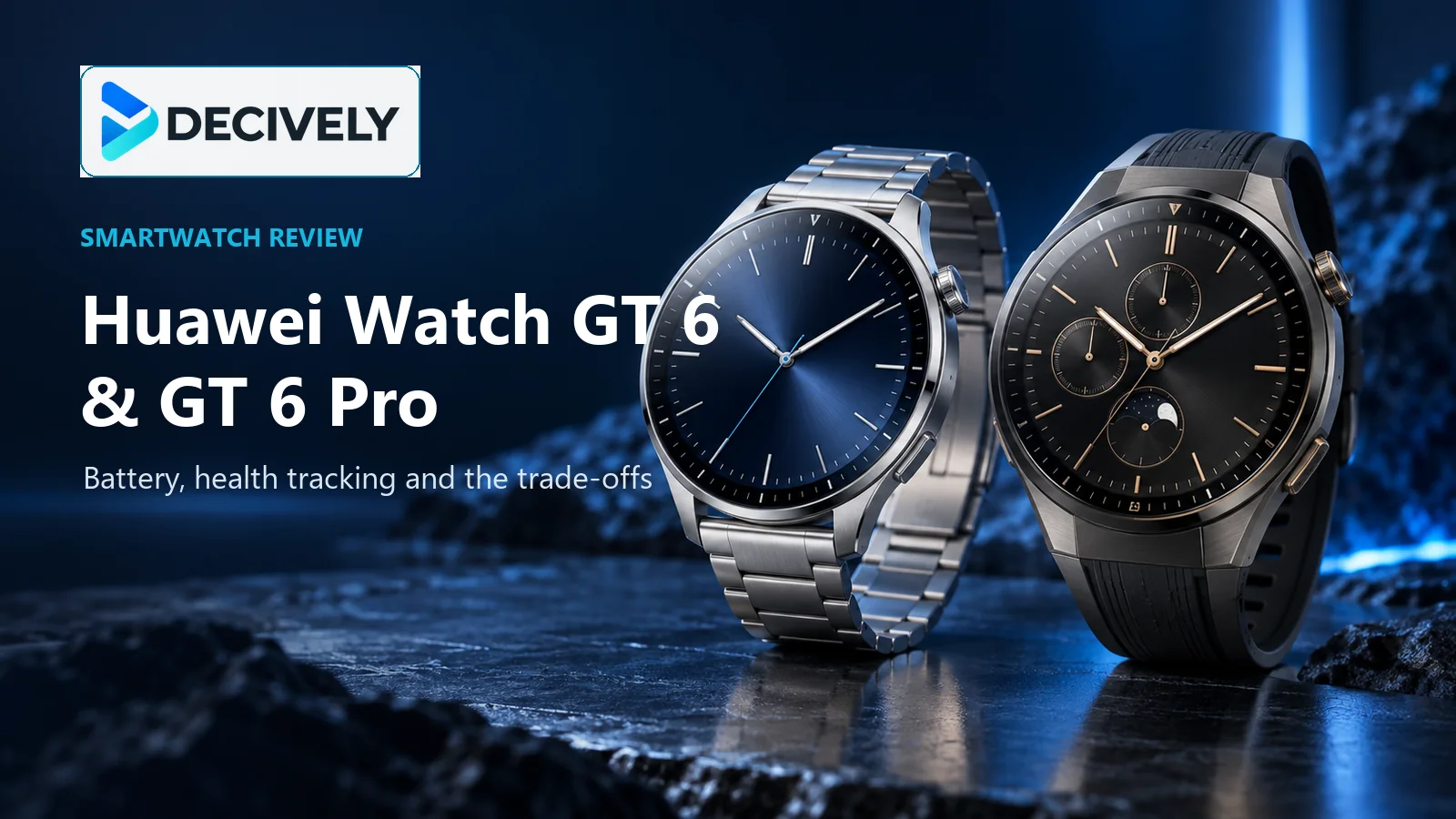
The Watch GT 6 is for people who want a smartwatch that can last for days instead of needing a nightly charge. The standard model comes in 41 mm and 46 mm sizes. The GT 6 Pro comes only in 46 mm and adds a titanium case, sapphire glass and ECG support. The key trade-off is simple: battery life and strong fitness tracking are the strengths; Google apps, Google Wallet and a large watch-app library are missing.
Decively has not tested or worn these watches. This guide compares Huawei’s official specifications with independent reviews and current retailer listings checked on 27 September 2026. Battery and health figures are explained as claims or reported results, and the health features should not be used for diagnosis.
Which GT 6 model should you choose?
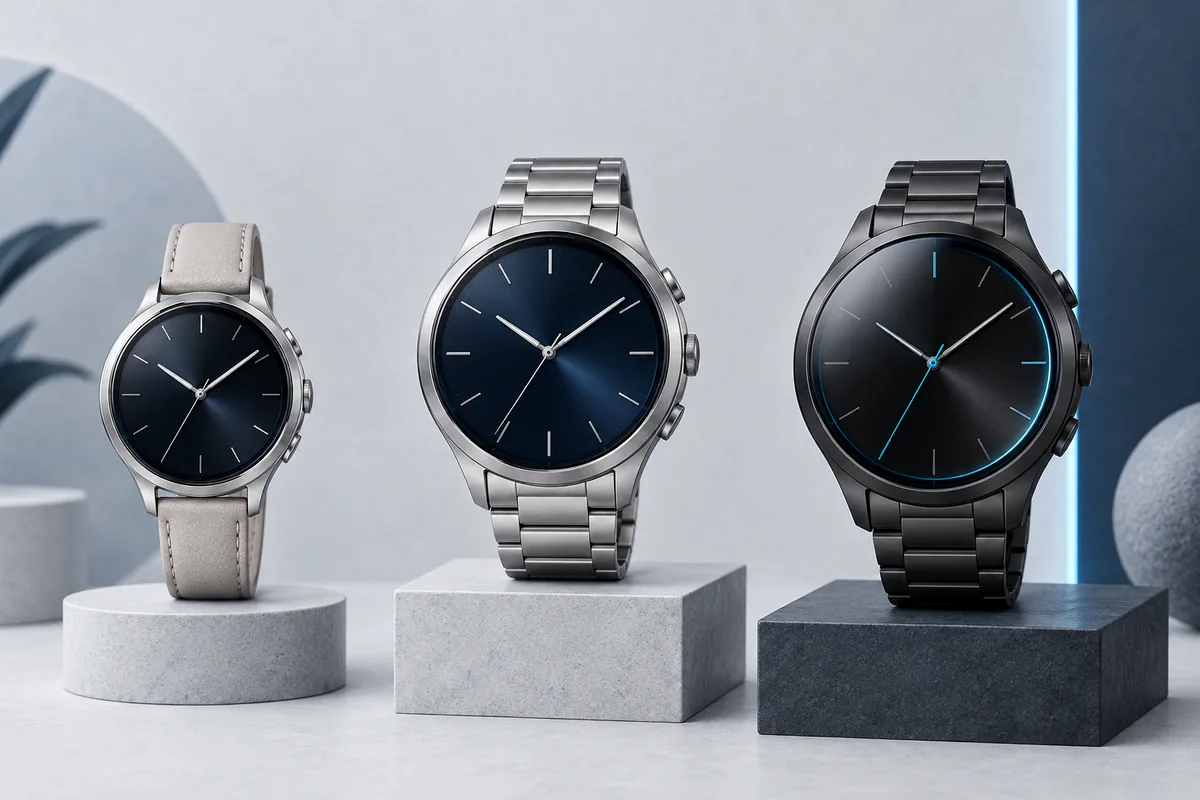
The easiest way to choose is by wrist size, materials and whether you need ECG. The two standard models use stainless steel. The Pro uses more premium materials and adds a few health and outdoor features.
41 mm · steel
GT 6, 41 mm
The smallest and lightest option. It weighs about 37.5 g without the strap, has a 1.32-inch AMOLED screen and the shorter battery claims. Choose it if a 46 mm watch feels too large.
46 mm · steel
GT 6, 46 mm
The standard larger model. It weighs about 51.3 g without the strap and has a 1.47-inch AMOLED screen. This is the best fit if you want the longest quoted battery life without paying for the Pro materials.
46 mm · titanium
GT 6 Pro
The premium 46 mm model. It weighs about 54.7 g without the strap and adds a titanium case, sapphire glass, a ceramic back and ECG support. The software and app limitations remain the same as on the standard GT 6.
Prices vary by finish, strap and retailer. On 27 September 2026, Greek listings started at about €190 for the standard GT 6 and about €275 for the GT 6 Pro with a fluoroelastomer strap. Titanium-bracelet versions cost considerably more, so compare the exact finish rather than the model name alone.
How long does the battery really last?
Huawei’s 21-day figure applies to the 46 mm models under light-use laboratory conditions. A more useful expectation is up to 12 days for Huawei’s typical-use test, or about 10 to 12 days in published reviews that included notifications, health tracking and GPS workouts. The 41 mm model has lower figures: up to 14 days in light use and 7 days in typical use.
Blue: Huawei's stated maximum
Cyan: top of the range in published reviews
Light use, Huawei's test
Up to 21 days. Workout auto-detection is off.
Typical use, Huawei's test
Up to 12 days. More exercise than the light-use test.
GPS workouts, as reviews describe them
About 10 to 12 days. Notifications and health tracking included.
Always-on screen, Huawei's test
Up to 7 days. The screen stays lit.
Always-on screen plus GPS, as reviews describe them
About 6 to 8 days.
The headline number is not a promise for every user. Huawei’s light-use test turns off automatic workout detection and assumes limited weekly exercise. If you use GPS often or keep the always-on display enabled, expect shorter battery life. Even then, the GT 6 generally lasts much longer than watches that need charging every day or two.
The chart uses Huawei’s 21-day light-use claim as the maximum scale. Blue bars show Huawei’s stated figures; cyan bars show the upper end reported by independent reviewers. These are guideposts, not a Decively test result.
Are the health sensors and GPS any good?
Heart-rate tracking is one of the strongest parts of the range. Independent reviewers found that the sensor followed rapid changes in effort better than many wrist-based trackers. Blood-oxygen readings also appeared consistent for everyday use. Sleep duration is generally useful, but the split between light, deep and REM sleep is less reliable and varies between reviewers.
GPS performance also receives strong feedback. Huawei says its new antenna and dual-band positioning improve accuracy over the GT 5. Reviewers generally found that routes stayed tidy in streets and under trees, with pace and distance close to dedicated sports watches. Treat Huawei’s percentage improvement as a comparison with its own previous model, not with Garmin.
How useful is the cycling power estimate?
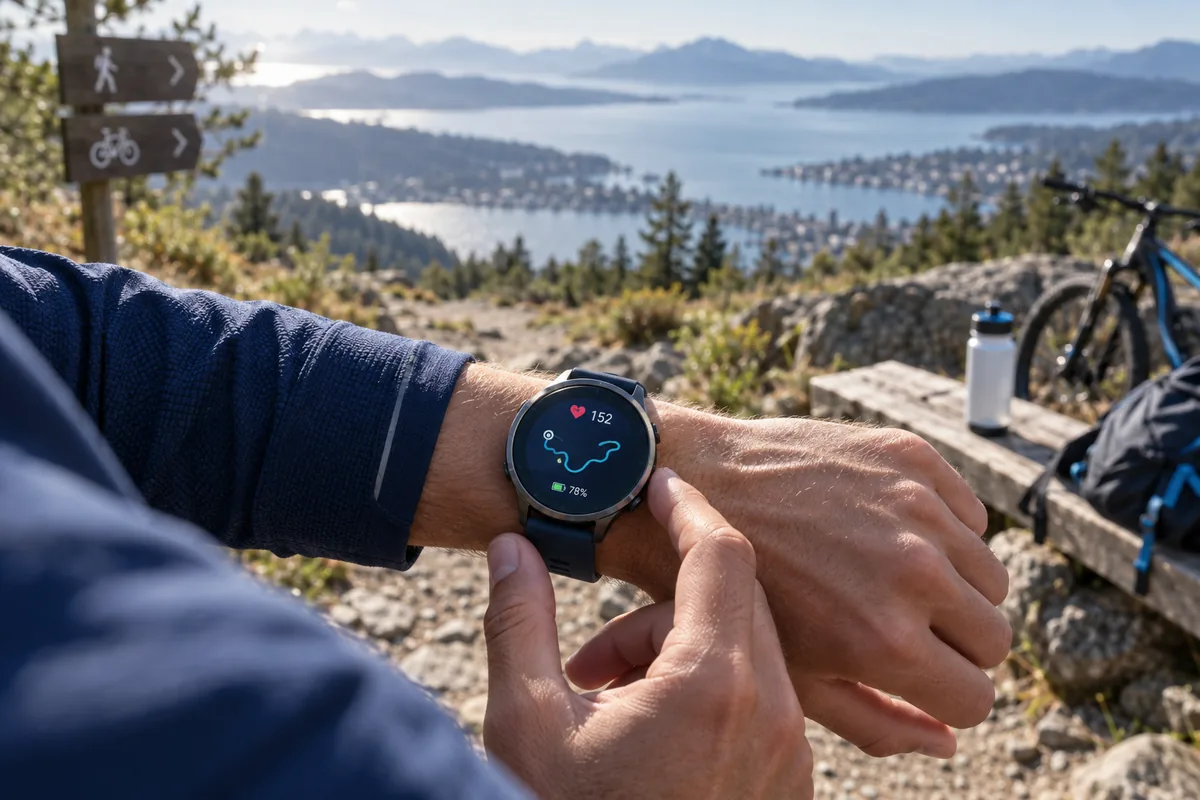
The watch can estimate cycling power without power-meter pedals. It combines speed, elevation and rider information to produce a rough watt figure. On a steady climb in calm weather, reviewers found it surprisingly close to a real meter. Wind and riding behind another cyclist can make the estimate much less accurate.
Calm climb, steady speed
Reviews say the estimate can sit close to a pedal meter.
Ordinary road, little wind
Still useful. The gap versus a real meter grows as the road changes.
Riding in the shelter of other riders
The watch cannot see that you are drafting, so the watts can be well off.
Strong headwind
Speed stays in the formula. The wind does not. Expect a poor match.
These bars summarise the pattern in published reviews; they are not test scores. The estimate is most useful in calm, steady conditions and least useful when wind or drafting changes the effort without changing speed in a predictable way.
If you already own a Bluetooth power meter, the watch can show its real data and record FTP. It can also broadcast heart rate to a compatible bike computer. Those are separate features from Huawei’s estimated cycling power.
The smart features you do not get
The main compromise is the app ecosystem. There is no Google Play Store or Google Wallet, and the watch does not offer the same range of apps, streaming services or message replies as an Apple Watch or Galaxy Watch. You can store music files on the watch, but music management is not supported from an iPhone.
It works with Android 9 or iOS 13 and later through Huawei Health, but iPhone users lose some features. Huawei lists music management, custom video watch faces and watch-based SOS among the limitations. Syncing workouts to Apple Health or Strava is also less dependable than on watches built around those ecosystems.
Contactless payment needs extra care. Google Wallet is not available. Some Android users report using Curve through Huawei’s AppGallery, but availability and rules can change by country. Treat it as a possible workaround and check it before buying, especially if wrist payments matter to you.
Problems to know about
Some owners report sudden battery drain after a software update, sometimes linked to a download that does not finish. This was not reproduced for this article. If battery life drops from roughly two weeks to only a few days, contact Huawei support and check whether an update is still running before assuming the battery has failed.
The standard model is rated 5 ATM for swimming, while the Pro is also marketed for free diving. Separate owner reports describe failures after salt-water swims, including on earlier GT models. That does not prove the GT 6 will fail in the sea, but regular sea swimmers should ask the retailer how salt-water damage is handled under warranty.
Indoor cyclists may also find the workout screens restrictive. Heart rate, power and cadence can sit on different pages, with limited control over what appears together. That is a screen-layout issue rather than a sensor problem.
How it compares with Garmin, Apple and Samsung
There is no single winner. The better choice depends on whether you care most about long battery life, training guidance or smart features.
Garmin
Choose Garmin if structured training, recovery advice and dependable workout syncing matter more than smartwatch-style features. Huawei records sessions well, but Garmin generally does more to turn the data into a training plan.
Apple Watch
Choose Apple Watch if you use an iPhone and want apps, rich replies, maps and Apple Pay on your wrist. Choose the GT 6 if charging every day or two is the bigger frustration and you can accept fewer smart features.
Samsung Galaxy Watch
Choose a Samsung Galaxy Watch if Google apps, Assistant and Wallet are essential. Choose the GT 6 if you would rather charge far less often and mainly want health and sports tracking.
Who should buy it?
A good fit
A good fit for Android users who want long battery life, reliable heart-rate and GPS tracking, and a watch that can stay on the wrist overnight. The 41 mm model suits smaller wrists. The 46 mm model offers the longest battery claims, while the Pro is for buyers who value premium materials and ECG support.
A poor fit
Look elsewhere if you need Google apps or Google Wallet, use an iPhone and want seamless workout syncing, or expect detailed training and recovery coaching. Regular sea swimmers should also clarify warranty coverage before buying.
What to check before you buy
Before buying, confirm four things: the exact model and strap, the price difference between the standard and Pro versions, whether your phone supports the features you want, and whether your preferred payment or fitness app works in your country. Storage figures and some retailer specifications still vary, so use Huawei’s official pages for the core specifications and treat shop listings as a guide.
Sources
Huawei's battery script and the 3,000-nit note are on the UK Watch GT 6 page. Greek specifications are on Huawei Greece. Reviews used for the sensor and battery picture include Wareable and GSMArena. Prices were checked on 27 September 2026 at Skroutz and Plaisio. Support dates are on Huawei's Greek Service Day page. Owner reports on updates, Strava, and swimming are from public threads and are labelled as such above. They are not a controlled test.