
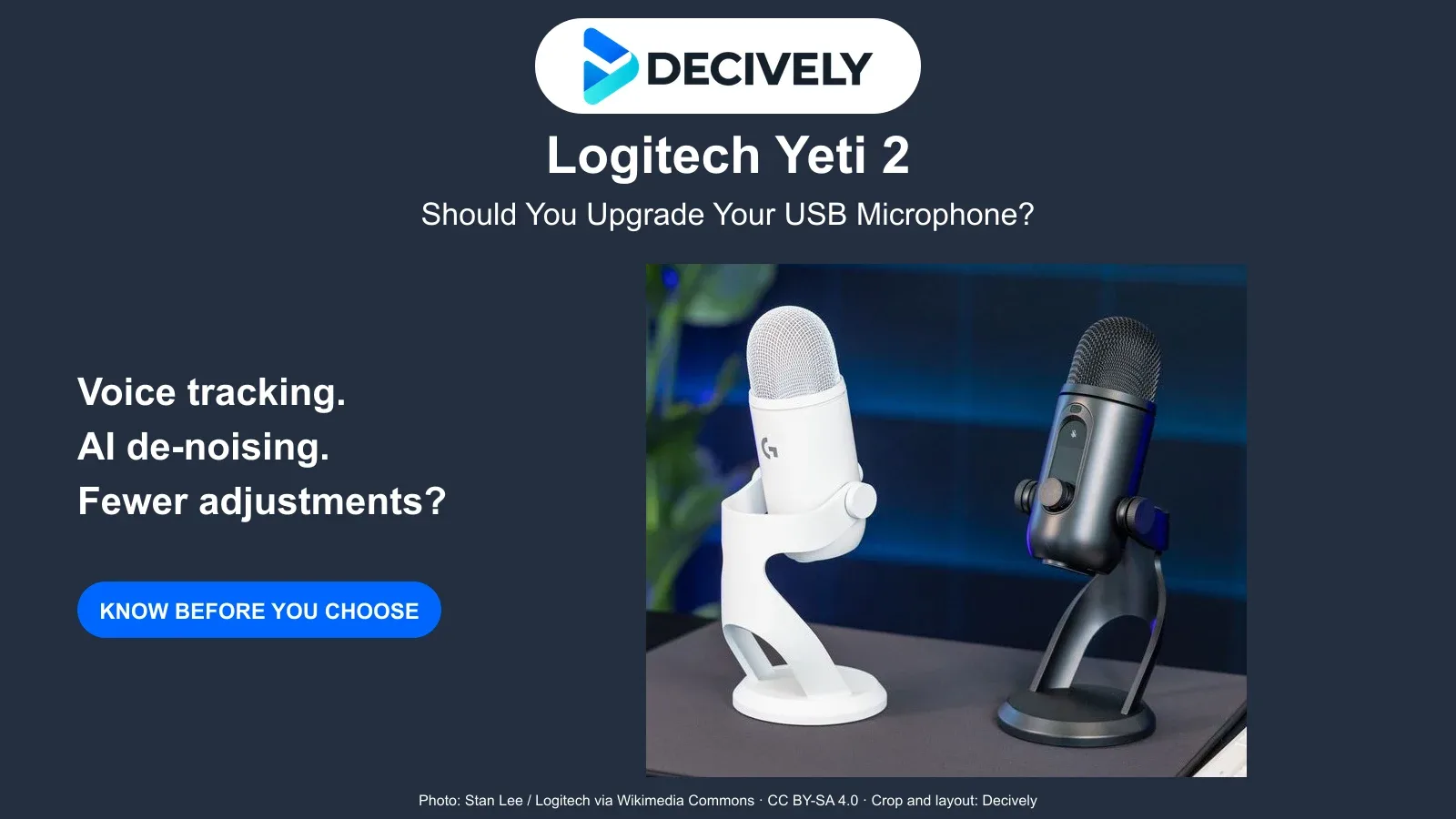
The Logitech Yeti 2 is aimed at people who want clearer streams, calls and voiceovers without constantly adjusting microphone settings. Announced on September 23, 2026, its main upgrade is automatic control of how your voice is captured, rather than a promise that every voice will sound better.
Quick verdict: buy for convenience, not an assumed sound upgrade
Consider Yeti 2 if you are buying your first desktop USB mic and regularly move while speaking or need help controlling background distractions. Keep a working Yeti or Yeti X if its sound is already consistent: the screen and automatic features alone do not establish better recording quality.
The practical trade-off is automation versus control. Early impressions are encouraging about noise reduction, but less uniform about vocal tone. A return option and a short recording comparison are more useful than a launch-day upgrade on faith.
What the new Yeti 2 changes
Early listening: useful de-noising, unsettled upgrade value
PC Gamer’s Jacob Fox briefly tried Yeti 2 at Logitech’s Warsaw launch event. He reported that voice following worked well, and that noise-reduction levels 1 and 2 removed surrounding chatter while retaining a full voice. At level 3, he heard some voice frequencies disappear. This was an event demonstration, not a controlled long-term comparison.
An early owner in r/LogitechG reported better keyboard-noise rejection between speech, but preferred the fuller tone of an older Yeti X. That is a single subjective report, not a defect rate or a consensus. Together, these experiences support a cautious conclusion: cleaner background audio and preferred vocal sound are separate purchasing questions.
Do not replace a microphone you already like solely because the new model uses AI. Listen to a recording with automatic processing on and off, in the application you actually use.
Distance and room sound still matter
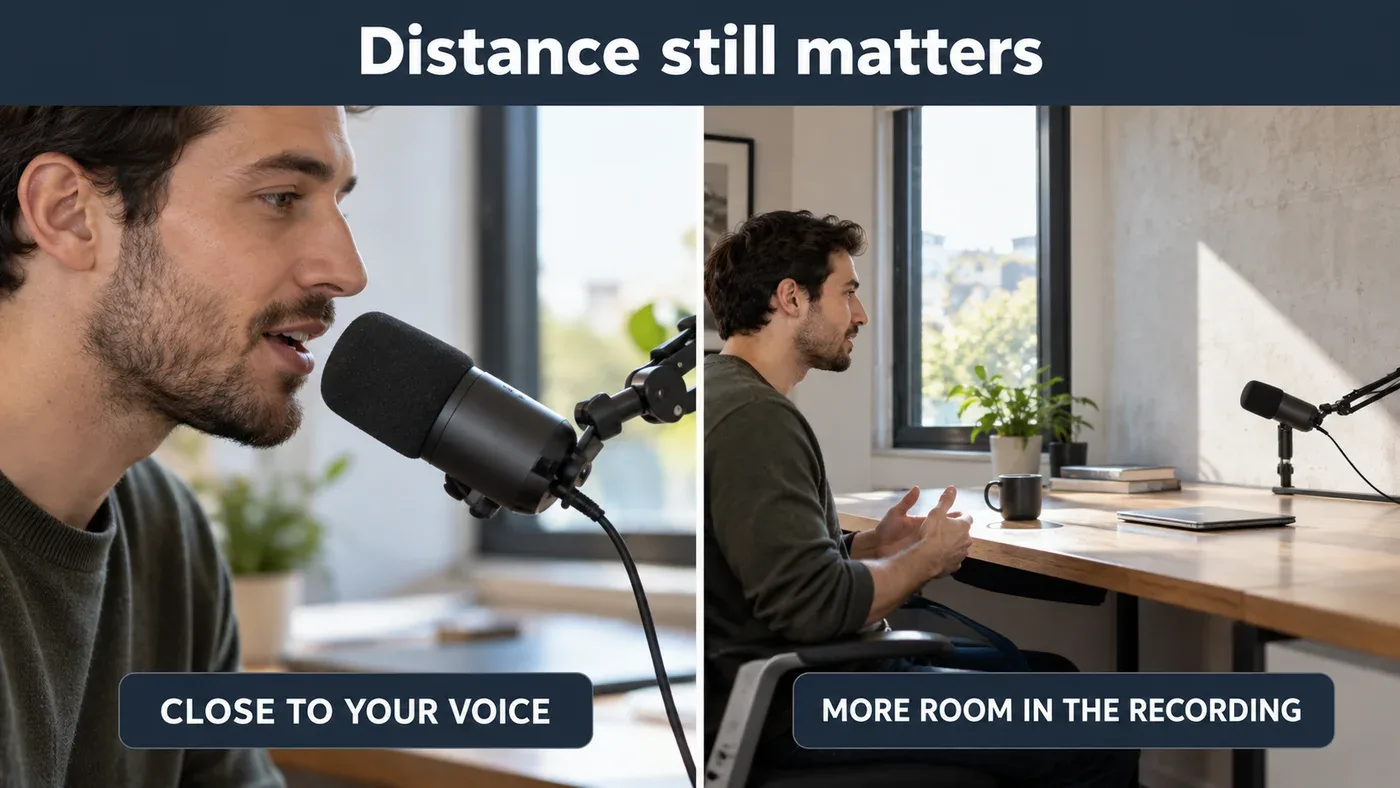
Illustration of voice distance and room sound; not a Yeti 2 photograph or an audio test.
A proximity sensor can adjust capture settings; it cannot make a desk on the far side of a reflective room equivalent to speaking close to the mic. That is our buying interpretation, not a measured Yeti 2 limitation. If echo is the main complaint, see what actually reduces room echo before expecting processing alone to solve it.
During the return period, record three short samples: normal conversation, typing while speaking, and leaning back. Compare the automatic mode with a fixed pattern and low de-noising. Judge clarity, changing volume and voice tone—not just the silence between sentences. Use the same app settings in each sample; avoid stacking multiple automatic processors without checking the result.
Yeti 2 versus the original Yeti
The original Yeti already offers multiple pickup patterns, a gain control and direct USB recording. Its Blue VO!CE filters require G HUB. Yeti 2 brings more processing and visual control onto the microphone itself. That difference can simplify a new setup; it does not make every older Yeti obsolete.
If your current mic produces clean recordings at a stable speaking distance, the sensible comparison is the cost of the upgrade against the time you actually spend fixing levels and noise. If that time is negligible, keep it.
Price and availability: check your regional listing
At the October 13 research check, Logitech’s US listing showed $159.99; its UK range listed £139.99. The product also appears in the official Canadian, Australian and European ranges. These are manufacturer-store observations, not guaranteed checkout prices or Amazon offers; taxes, shipping and availability vary.
Buy the product specifically labelled Yeti 2, not Yeti GX, Yeti X or the original Yeti. Before ordering, confirm the computer and G HUB requirements, included cable, local warranty and return conditions.
Research notes
Checked October 13, 2026. Decively has not physically tested Yeti 2. Official specifications and launch claims are separated from PC Gamer’s brief hands-on demonstration and one early owner’s subjective experience. No unannounced future feature is treated as available. The US product-page specification accordion did not expose its content during our check; platform and recording specifications were cross-checked against the official Japanese release, without assuming identical regional box contents.
Featured photograph: Stan Lee / Logitech, via Wikimedia Commons, listed under CC BY-SA 4.0. Crop, resize and layout by Decively; photograph adaptation shares that license. The Decively logo remains a separate protected brand mark. The source page’s permission-email review is pending; the listed license is not represented as independently validated. Body scene: explanatory illustration of a generic setup, not a Yeti 2 photograph or recording test.
Logitech: September 23 announcement
Logitech G: Yeti 2 US features and current store price
Logicool: official recording specifications and computer compatibility
Logitech G: original Yeti controls and Blue VO!CE requirements
Logitech G: UK range and regional pricing
PC Gamer: Jacob Fox’s launch-event hands-on impressions
Reddit: one early owner’s Yeti X comparison, not a consensus